25 February 2019

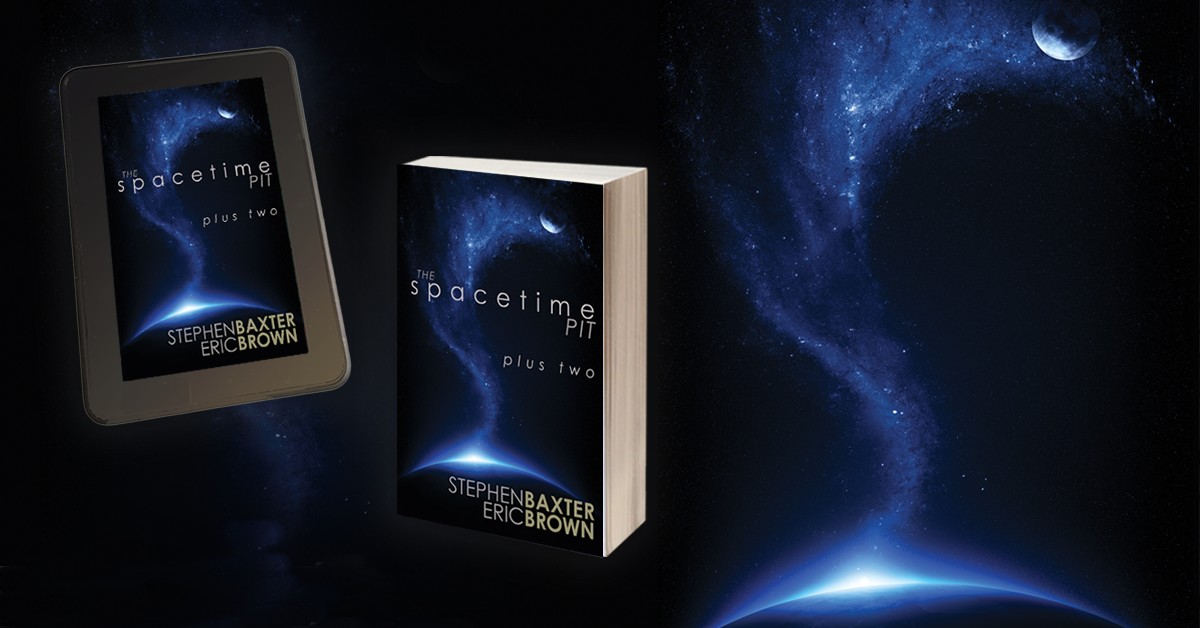
The Spacetime Pit Plus Two by Stephen Baxter & Eric Brown

Spacetime Pit Plus Two collects three collaborative stories by two of science fiction's finest writers. Never before published in one volume, the triptych showcases the authors' ability to create narratives on a vast scale, and yet never to lose sight of the all-important human element.

In the award-winning The Spacetime Pit, spacer Katerina Wake crash-lands on a primitive alien world and faces certain death unless she can harness her ingenuity, and technical know-how, to bend the destiny of an entire race to her will...

Green-Eyed Monster follows Richard as he wakes up after a night on the tiles to find himself inhabiting the body of a toad – and that's just the start of his troubles...

In Sunfly, Onara and her people live on a world very different from our own – a vast ribbon encircling a sun. But a change is coming to the land, a mysterious narrowing that threatens not only the stability of her world, but the very order of everything she has taken for granted.

***** *** *******

What a gem of a collection this is! Mind you, I shouldn’t be surprised given that the three stories contained in this book are a collaboration between two of Britain's best sci-fi authors. They are quick reads which flow very well, testament to the skill of their creators. Both Baxter and Brown will need no introduction to readers familiar with contemporary sci-fi literature, and anybody new to or exploring the genre should really have a look at this as a fine sample of their work. Apparently, according to Brown in the Introduction, The Spacetime Pit began when he and Baxter met to work on some ideas back in 1995 after which it won the 1996 Interzone magazine readers’ poll for best story. This success obviously encouraged them to continue working together on stories whenever time would permit and I'm exceedingly glad that they did because it's a really good piece of work. In summary, this is an excellent little collection that is a quick yet superbly enjoyable read. I can think of no better way than to spend a couple of hours on a lazy afternoon. Anyway, I shall wax lyrical no more, so here is a quick rundown of the stories:

NOTE: I always try not to, but there's the possibly of some minor spoilers ahead (but no plot giveaways) so don't read on if you’re sensitive to such things.

The Spacetime Pit
Eric Brown himself describes this as "a grim tale that spans billions of years, but has the dilemma of a human being at its very core" which is a perfect description. An explorer of a world one hundred light-years from Earth becomes marooned and has to think creatively to try and get herself off the planet and back up to the orbiting station in which she is based. She has a survival pod which enables her to enter extended periods of total stasis and she uses this ability in her attempt to create a situation in which she can recover from her predicament. The world-building in here is excellent and the style used is slick and easy to follow.
My rating: 4.5/5

Green-Eyed Monster
A more humorous story here, largely told from the point of view of a toad (yes, an actual toad). In a nutshell, a chap experiences through a bit of alien intervention, "bodily transmogrification" and sees his life and surroundings from a series of new perspectives. I enjoyed this one mostly due to the sheer unusual nature of it and also for how human the story was - even from the point of view if a toad. The ending is great. A nice lighthearted story that will make you chuckle occasionally.
My rating: 4/5

Sunfly
I rate this as the real jewel of the collection, absolutely wonderful as a quick absorbing read with a great "sense of wonder" element that drew me in deeply right from the first words. Set on a huge ring-world type structure which is facing impending and catastrophic change, it's a journey of discovery for the main character as she discovers truths about the amazing world on which she lives. This one felt like classic Eric Brown and this is no doubt the main reason why I connected with it and enjoyed it so much. Brown has a real knack with this type of story and those of you familiar with his work will have an idea of what I'm talking about. If you like Brown's work, you will enjoy this. Heck, you'll enjoy it even if you've never heard of either Brown or Baxter, it's a fine sci-fi adventure with a good conclusion. An excellent story.
My rating: 5/5

Total Rating:
= 4.5 out of 5
Buy the ebook HERE (Amazon US)
Buy the paper book HERE (Book Depository)


23 February 2019

BOOK REVIEW: Abandoned (Donovan Trilogy #2) by W. Michael Gear

The second book in a thrilling sci-fi action adventure, set on Donovan, a treacherous alien planet where corporate threats and dangerous creatures imperil the lives of the planet's colonists.

The struggle for survival sharpens as resources dwindle, technology fails, and the grim reality of life on Donovan unfolds.
Supervisor Kalico Aguila has bet everything on a fragile settlement far south of Port Authority. There, she has carved a farm and mine out of wilderness. But Donovan is closing in. When conditions couldn't get worse, a murderous peril descends out of Donovan's sky--one that will leave Kalico bleeding and shattered.
Talina Perez gambles her life and reputation in a bid to atone for ruthlessly murdering a woman's husband years ago. Ironically, saving Dya Simonov may save them all.
Lieutenant Deb Spiro is losing it, and by killing a little girl's pet alien, she may have precipitated disaster for all. In the end, the only hope will lie with a "lost" colony, and the alien-infested reflexes possessed by Security Officer Talina Perez.
On Donovan, only human beings are more terrifying than the wildlife.

***** *** *******

After reading and thoroughly enjoying Outpost which was the first novel of this series (see my review HERE), I needed no extra encouragement to pick up the next book of the trilogy at the very first opportunity. Again, it's a quick-moving beauty that follows on directly from the first book with more of the same "space-western" style action set on the faraway planet of Donovan. This planet is full weird and wonderful ecology which is resisting human attempts to plunder its resources, and we're given more alluring clues about this fascinating place as the engaging story progresses.

The same characters are present, plus a few new ones and the development of these players seem to step up a notch. As is often the case with me, I found that my favourite characters were the not-so-nice ones. There's a number of scoundrels in this story but their contemptible and underhanded deeds really do spice up the story nicely. To be honest, I'm expecting book three to be quite climactic because this one definitely seemed to be mostly concerned with continuing to prepare the scene by offering many more small yet supremely tantalizing hints about motivations and plans. The world-building is again excellent and W. Michael Gear's skills have really come as a pleasant surprise to me, his use of adjectives being superb and easily understood yet not overdone. Each time that I sat down to read this I was immediately drawn into the setting and to the people therein, the real world becoming faint and blurry until I came back out again. This is the mark of great storytelling and it usually doesn't really bother me all that much how good the story is if the author can successfully drag me into their yarn where I can almost become part of it. This book is very much like (while being of excellent quality) that even though it's told in the third person and past tense.

So, if you've read Outpost, you will get into this and probably love it as I did. If you haven't read Outpost, then you need to because it's required reading to set you up for this book. Book three Pariah is due out mid-May 2019 and you can quite safely bet your last SDR (the unit of currency on Donovan) that I will be getting it for myself. I might even write a review of it for you if it's any good, but somehow I think it'll be another beauty if the first two are any indication. A great book.

4/5 for concept
5/5 for delivery
5/5 for entertainment
= 4.7 out of 5
Buy the ebook HERE (Amazon US)
Buy the paper book HERE (Book Depository)

28 January 2019

BOOK REVIEW: The First Protectors by Victor Godinez

My rating: 4 out of 5

The last thing Ben Shepherd wanted was another war. But sometimes the universe won’t take no for an answer.

His body and spirit mangled by a lifetime of combat, Shepherd has retreated to the desolate desert of New Mexico to heal his wounds and dodge his demons. All he wants now is peace and quiet.

Both are shattered one starry night when an alien ship crashes nearby. Out of the ship crawls the last, dying member of a conquered civilization. It’s been shot down by an extraterrestrial enemy, the vanguard of a ravenous force hunting for a new homeland. With its last gasp, the wounded alien injects Shepherd with a high-tech serum that gives him near superhuman powers.

Now, with a new body but a soul as fractured as ever, Shepherd becomes the reluctant leader of the human resistance against the coming invasion. With enemies on all sides, the man who couldn’t bear the guilt of seeing one more friend die in battle now finds himself charged with protecting the entire planet.

***** *** *******

From my very first look at this, I was determined to get hold of it, as were a number of other like-minded readers whom I know. It sounds great, a worn-out soldier receiving a dose of something from a dying alien which will help him to lead the human race in a desperate defence of our beautiful blue planet from another more advanced alien species bent on taking it for themselves. In this book, which is obviously the beginning of a planned series, we’re promised a fast-paced and action-filled caper which blasts us across Earth and Earth-space and that's what we get, pure and simple, a fun military flavoured sci-fi adventure that makes up with pure entertainment for what it lacks in detail and description.

Admittedly alien invasion is in no way a new idea but it just continues to work so well. I certainly enjoy it and I'll wager that it'll remain a solid and popular sci-fi trope forever. The idea has been done and done well by so many authors [probably most have had a crack at it at some stage] in the genre, but it will never fail to grab the imagination of those who like to ponder the likelihood of extraterrestrial beings and wonder what form those beings might take. Whether or not said lifeforms will be benevolent or malevolent is an interesting thing to ponder and in this first offering from Victor Godinez we are introduced to one of each type. Our leading character, a tired and injured Navy SEAL, is injected with a high-tech serum which transforms him into a "super soldier" with superhuman abilities and with these he leads the battle against the invading aliens. As well as Ben's powers, humanity is given an incredibly vast quantity of technical data which enable the production of machines, gadgets and weapons that amount to a technological leap of hundreds of years. This knowledge is required if we're to have any hope of holding off the invaders. The tech and weaponry is probably the best aspect of this story and lovers of such things will enjoy the explosions. The descriptions for this sort of stuff were fine, possibly even a tad too much, but that is obviously the author's thing and that's fine by me, and lovers of cool shit and shoot-'em-up romps will get right into this. The plot is simple but certainly adequate and contains enough intrigue which has an enticing little twist right at the end which (I think) sets up where the next episode of the story may be headed.

It's well written, especially the action scenes, and I found it to be an easy and swift read with the pages bolting past at a rate like I've not experienced for some time. While this is definitely not a bad thing, I cannot help but suggest that Godinez may have overlooked some details, which would've greatly enhanced his story for me, for the sake of fitting the epic action into his word count. Probably the final third of the book is a big final battle and I admit to beginning to yawn just a little toward the end. Having said that, the quality of the action and it's writing kept me hooked no worries at all. But, to shift back to the negative again, I was waiting and waiting for some decent detail about the alien species which (unless I missed it) never materialized. At the beginning of the book, we have a basic description of both alien species but this isn't built upon to any real degree and this was disappointing especially since we see so much of the invading aliens during the big battles. We don't get "inside the heads" of any of the ET's. Sure, we learn a little of the background of why the aliens have set their sights on us from information furnished from the massive information transfer, but it's not enough for my liking. Hopefully, book two will fill in some of these gaps.

From a pure entertainment standpoint, The First Protectors is hard to fault, to be honest, and I devoured it easily. I just wish that the information level had been lifted slightly above the point of where it currently sits, that is I wanted a bit more detail of the greater story picture rather than being focused on us down here a so much. But for the kind of entertainment that it is, and what the author no doubt was trying to achieve, it's pretty good.

It would've probably have been a 5 out of 5 book for me had I been disappointed with the lack of detail about the aliens, etc. As it sits, it's not too bad at all and I will be watching for Godinez with great interest. He's yet another fresh new name to appear in the science fiction field in recent years and hopefully destined for great things. I just hope that he doesn't rush into the next book but rather takes the time to give us a little more "flesh and blood", even if it's at the expense of a few technical details or deafening explosions.

3/5 for concept
4/5 for delivery
5/5 for entertainment
= 4 out of 5
Buy the ebook HERE (Amazon)
Buy the paper book HERE (Book Depository)

15 January 2019

BOOK REVIEW: Battlefield Earth: A Saga of the Year 3000 by L. Ron Hubbard

My rating: 2 out of 5

IN THE YEAR 3000AD, Earth is a barren wasteland, plundered of its natural resources by alien conquerors known as Psyclos. Fewer than thirty-five thousand humans survive in a handful of communities scattered across the face of a post-apocalyptic Earth.
From the ashes of humanity rises a young hero, Jonnie Goodboy Tyler. Setting off on an initial quest to discover a hidden evil, Jonnie unlocks the mystery of humanities demise and unearths a crucial weakness in their oppressors. Spreading the seeds of revolt, Jonnie and a small band of survivors pit their quest for freedom in an all-out rebellion that erupts across the continents of Earth and the cosmic sprawl of the Psychlo empire.
For the fate of the galaxy lies on the Battlefield of Earth.

***** *** *******

What a freakin' epic-sounding sci-fi adventure! And, at a bit over 1200 pages in paperback guise, it certainly looks epic too. I will say right from the start that the presentation of this book, in both print and ebook form is top-notch. In the case of the paperback version that I read mostly from, it's a well-bound and nicely presented example with great cover art, good typesetting and very few typo errors to distract. The ebook that I sampled is similarly well done with great formatting and indexing, etc. The edition that I read is the "21st Century Edition" published in 2017 [it was written in 1980] with an introduction by the author telling us all about how and why he got to the point of writing this book and there's a reasonable extensive interview and short essay about the author at the end. I'm only giving my opinion of the story itself here, but these additional sections do make for some interesting reading in themselves. All in all, it's a nicely presented novel, and the marketing has certainly been energetic, to say the least. So with it being so great-sounding, great-looking and with the author claiming that "it is the only one I ever wrote just to amuse myself", does this L. Ron Hubbard opus live up to all (or any) of my expectations?  Well, mmm...yeah-nah. Let me explain...

I'm a New Zealander and us Kiwis commonly use the slang term "yeah-nah" which is essentially a combination of both yes and no, meaning "kind of" or "I get what you’re saying, but no", that sort of thing. Well, these two words sum up my feelings for this book very well; if there ever was a book whose press relations build up far outweighs its actual quality as a novel, it is this one. In what is surely an attempt to restore the late L. Ron Hubbard's reputation as a sci-fi author in the modern era, the publishers [Scientology-owned Galaxy Press] of this have done a bang-up job of hyping up a book which is, while definitely epic and modestly entertaining, nothing at all like the marketing spin portrays. In fact, it has been alleged that members of the Church of Scientology are largely responsible for propelling this book to the top of best-seller lists by bulk buying (then recirculating and re-buying) copies to influence the sales figures. That wouldn't surprise me in the least. Anyway, that aside, I've reviewed this book on its own merits for what it is and hopefully without undue prejudice.

With reasonably efficient use of words at the beginning, Hubbard lays the foundation of his story and the bleak post-apocalyptic world in which it takes place. It reads okay, albeit quite dated and erroneous in terminology [the numerous misuses of the word annealed particularly bugged me] but otherwise it cruises along not too badly. Right from the start, the Hubbard's pulp fiction roots show, and the style is reminiscent of other early action and western books that I remember from my Dad's collection, with enticing cover artwork and rollicking yarns within the pages. Hubbard actually states that when he wrote this novel "I wanted to write pure science fiction...and not in the old tradition...writing forms and styles have changed, so I had to bring myself up to date and modernize the styles and patterns." Well, I'm not so sure that he succeeded in this, but its mostly fine by me because [as those of you who have read other reviews of mine will know] I usually enjoy the old-school pulp style and relish the simple escapism that it allows, one of the key reasons why I read this sort of stuff in first place. The story is chronological and easy enough to follow for the most part, but the layout of the chapters seemed a tad complex and non-nonsensical to me; the novel is broken up into 32 parts which have up to ten or so chapters. The division into parts didn't really seem to occur at particularly significant stages of the story, rather it just seemed to serve the purpose of resetting the chapter count so it didn't go astronomically high and appear too daunting to the reader [over 300 chapters!].  Anyway, I digress, but I'll state that I thought that the writing style was [for me] mostly okay. However, I'll wager that the majority of today's readers won't particularly enjoy its feel and style as much as I did. I reckon that fans of more contemporary science fiction will find it a little lame and maybe even frustrating and I think they will know within a few pages or so whether or not they're going to get along with it.
Our hero - Jonnie Goodboy Tyler
The story itself is sound enough but nothing at all ground-breaking or startling. The Psychlo aliens are a nasty bunch of resource-hungry miners who have wiped out almost all of the human population on Earth [as well as many other planets], the survivors scattered across the planet and living in hiding for the last thousand years or so, reverting to old customs and ways. The big change begins when Terl, an enterprising Psyclo with a bit of authority, decides to investigate the possibility of training some human "animals" to secretly do some manual work that the Psyclos themselves are unable to do. You see, there is a simple yet rather crucial complication with the gas that they are required to breathe while outside their sealed habitation domes. By using the humans as labour will allow Terl to secure for himself quite a haul of mineral wealth right under the noses of his Intergalactic Mining Company bosses. What he doesn't bank on is the intelligence of these humans. You see, the Psyclos have been rampaging about raping the galaxy and its other races for millennia largely unopposed, so the concept of any other species being able to outsmart them is totally unthinkable. As far as they're concerned, they're at the top of the heap. That is until they meet our buckskin-clad hero Jonnie Goodboy Tyler, a likely lad of a "muscular six feet shining with the bronzed health of his twenty years" and who looks to be just the chap to unite the human race against these cruelest of oppressors. A big ask, but he's the man for the job.

What follows is a moderately entertaining but long-winded tale of uprising and eventual triumph over the invaders. Thankfully, the last quarter of the book does take on a new level of interest with a bunch of new players entering the game (like lots of new and generally interesting alien species) and there is a rather unexpected and slightly amusing plot twist. Right throughout, Hubbard does tend to get sidetracked with trivial details of things such as financial dealings, political posturing or technical details and I feel that these most often bogged the flow of the story down too much. As usual in these situations, I found myself skipping over a number of paragraphs in an attempt to get back to the guts of the story, and if I start doing this while I'm reading a book, I know that it hasn't really got me on the hook. This pretty much turned into a 1200-page endurance test that stretched my curiosity to it's limit. Oh the things we do. I was trying to find out whether or not L. Ron Hubbard's reputation was deserved, whether he is able to actually produce great sci-fi or is this book [as I suspected and mentioned earlier] an overrated attempt to raise an old author's profile in aid of his other "serious subjects". I have to come down on the side of the latter. Hubbard will have put so much into this novel and good on him for doing so, especially if it was just for his own amusement, but I didn't get much out of reading it at all. I actually did really enjoy Hubbard's own introduction where he talks about his work as a science fiction author for the pulps in the Golden Age and what led him to the point of writing this book, but that was about the only highlight from all of those pages. I might have enjoyed this as a teen if it was divided into smaller parts but, even then, probably not.

I was really hoping that I was going to sit here and write you all a long glowing review of Battlefield Earth, and how it has really blown me away by being an epic masterpiece of science fiction from a true master of the art. But, it's not. What it is is a mildly entertaining [but far too long] story that ended up becoming quite an arduous read. Unless you're like me a lot of the time and your inquisitiveness knows no bounds, you won't thank yourself for picking this one up.

***** *** *******

2/5 for concept
2/5 for delivery
2/5 for entertainment
= 2 out of 5


Buy the ebook HERE (Amazon)
Buy the paper book HERE (Book Depository)


16 December 2018

BOOK REVIEW: Beacon 23: The Complete Novel by Hugh Howey

My rating: 3.3 out of 5

This is the first work of Howey's that I've read so far and is the combination of five previously serialized novellas. The storyline centres around a lonely and tormented chap who mans a remote NASA interstellar beacon station (essentially a lighthouse operator in outer space) which warns passing vessels of a vast asteroid field nearby. There's a lot of traffic moving about the galaxy at faster-than-light speeds in this far-future setting, human and alien, as well as a vast galactic war going on, so these beacons are highly necessary pieces of equipment.

Heavily character-driven, the simple and bare setting of the beacons brings the characters into sharp relief, and we get a really good look inside the main character's head. A combat veteran of the previously mentioned galactic war, this guy (whose name I don't recall learning) carried with him his fair share of demons and there are many tumultuous thoughts swirling around inside his head. Combine with this a number of unfortunate events to do with his beacon and life is not particularly plain-sailing for him. We're right there with him as he experiences a number of what appear to be psychotic episodes, but as the story progresses you get the sense that he may be a little more than he initially seems to be.

The story moves along well, and the plot is okay and kept me interested enough to keep going without effort. Howey's writing style is great and he uses some good gritty language and dialogue which I always enjoy. I'm naturally assuming that his other series (Wool and Shift, etc.) are similarly good given their popularity. However, I wasn't as entertained by this one as I like and hoped to be. That's not to say that it isn't a good book, it's just that I found myself early on wanting to move out of the main character's mind and into a bigger and more encompassing story. Maybe that's coming? Perhaps Howey has further plans for this setting, and this would most definitely be a good thing.

Overall I think it's an average read, and probably enough to get me to explore some of the author's other works. Give it a crack if you have some spare space in your reading schedule because it is easy going and well written enough to earn a look. I just wanted a little more.

3/5 for concept
4/5 for delivery
3/5 for entertainment
= 3.3 out of 5

Buy the ebook HERE (Amazon)
Buy the paper book HERE (Book Depository)

30 November 2018

BOOK REVIEW: Inside Scientology: The Story of America's Most Secretive Religion by Janet Reitman

My rating: 4.3 out of 5


Scientology intrigues me, not that I particularly like to admit it sometimes. Like a number other groups labeled as cults or religious aberrations, their often negative publicity arouses my distrustful yet inquisitive curiosity and I’m suddenly keen to find out why this movement attracts so much flak. Of course (by virtue of being an avid science fiction fan) I'm well aware of L. Ron Hubbard and where he sits on the science fiction landscape, and this made me doubly curious to see what exactly it was that he came up with. Why did his ideas spawn this large esoteric and now wealthy global organization with seemingly so much influence? How could it turn him into such a god-like figure, with his image and name effectively becoming idols? Inside Scientology sounded like it might begin to answer these questions and be an ideal starting point for a person like me, so when the opportunity to pick it up came along I leaped at the chance. A little background checking reveals that Janet Reitman is a well-known journalist in the entertainment field and her credentials appear solid. She's worked for top publications like Rolling Stone magazine, and her skills shine through in this good piece of investigative writing. She’s connected well enough to gain access to both current and active Scientology members as well as to many high profile ex-members and the result is a very interesting read.

Dianetics - 1st Edition 1950
L. Ron Hubbard
The history of L. Ron Hubbard and his philosophies has been widely chronicled in many books previously but this book offers a good and fairly current overview (published 2011) of the key points. Divided into four main parts, this book begins with a decent study of Hubbard’s early life and work, the establishment of his theories of self-help mental health and his ideas about how to treat sicknesses that exist in people. As the pages turn, more is revealed about the initial rise and fall of his invention Dianetics followed by its rebirth and evolution to become the Scientology movement, which was later declared a bonafide religion (in the eyes of the law anyway) as The Church Of Scientology. I was particularly fascinated with the story of how Hubbard and his band of followers arranged themselves into an actual sea-going “navy” complete with uniforms and ships, taking their small fleet to various ports around the place with the goal of spreading their faith and ideals. This, along with Hubbard’s short and unusual career in the U.S. Navy during World War Two, explains the nautical themes that often pop up in Scientology, including the name of their elite division called The Sea Organisation (or Sea Org) which I had previously found slightly odd. As things move on and the Church grows, the transformation to a mega-corporation is quite swift and rather incredible. After the death of Hubbard in 1986 the Church takes on a number of new tactics, not least of these is the concerted recruitment and use of celebrities who can utilize their profile and status to spread the Scientology word. This is possibly the most well-known aspect of Scientology for many of us, and this book presents an insightful view of the involvement of people like Tom Cruise and John Travolta. Also, we read about some key high profile events that occurred in and around Scientology as well as the life of it’s powerful and rather mysterious current leader David Miscavige, a man who seems to me to have backed himself into a very tight corner and is fighting said corner quite savagely.


Some years ago I’d read about the story of Xenu that Hubbard had come up with but I had no idea that Scientologists actually believe it to be the history of mankind and the main reasons for our woes, our mental health (or lack of) in particular. Without delving into the details and my own views of Scientology (and not meaning to trash their charitable works) it certainly does appear that, given the evidence presented, the movement was created at its core to make money above other things, and this book presents very well the methods and tactics which they employed to achieve this. Of the people that the author interviews closely, she seems to have struck pay dirt because the insights that they give are revealing. In fact, Reitman claims that “not a single one of these people had ever spoken publicly prior to my interviewing them” and “all references to these people, their stories, and their quoted words come from my own interviews and conversations with them.” Her writing style is very good (as one would expect), easy to read with no wasted words just filling up space, all of it telling the reader interesting things cohesive with the overall subject.

Scientology logo
All in all, it’s a well-packaged essay about Hubbard and Scientology that certainly answered many of the questions that I had. If there’s one thing that I’ve learned from reading this book it’s this: L. Ron Hubbard had an impressive mind, imagination by the ship-load and a fair chunk of charisma which all worked together to create something rather weird yet strangely successful. While I still cannot fathom just how Scientology has become what it has, Inside Scientology does present very well the reasons why the people within the movement believe what they do and their motivations to spread their faith. The vehicle of that faith, The Church Of Scientology, sounds very much as though it has some issues, severe issues which cause not a little grief that we just don’t need in this world. Okay, they’re not the only movement like this and not even in the same playing field as the worst but, still, are they doing more good than bad around the place? I’m not so sure that they are, and you’ll be able to take a more considered position yourself if you read this book. It's definitely a recommended read for those with an interest in such things.

4/5 for theme
5/5 for delivery
4/5 for education
= 4.3 out of 5

Buy the book HERE (Book Depository)

23 October 2018

BOOK REVIEW [Reblog]: Salvage by Eric Brown

A couple of days ago I was asked by a friend for some advice on what sci-fi book they should pick up next. I asked them what they'd like to read and the answer was "something entertaining and interesting yet not too long or involved." Salvage was one of the first books to pop into my head, and the more we discussed what it is that they like, became more and more a match. I'm happy to report that they are loving it so far, just as I thought they would.

Anyway, this prompted me to reblog a short review which I did a few years back:

***** *** *******

My rating: 4.7 out of 5

Synopsis:

When Salvageman Ed saves Ella Rodriguez from spider-drones on the pleasure planet of Sinclair’s Landfall, he has no idea what he’s letting himself in for. Ella is not at all what she seems, as he’s soon about to find out.

What follows, as the spider-drones and the Hayakawa Organisation chase Ed, Ella and engineer Karrie light-years across space, is a fast-paced adventure with Ed learning more about Ella – and about himself – than he ever expected.

The Salvageman Ed series of linked stories – four of which appear here for the first time – combine action, humour and pathos, from the master of character-based adventure science fiction.

----- --- -------

This is the first short story collection of Brown's that I've read. It's a group of stories that are all linked together by the characters and the general 'journey' of the stories, similar to Kethani which is another collection of his stories that blend together into a fine novel length book.

Salvage reads great and has a really fun 'pulp sci-fi' feel going on that I totally loved. At times I was reminded almost of some old Perry Rhodan stories that I've read in years gone by but with a little more finesse. There are all the elements there for great stories - FTL starships, robots, AI, aliens, weird and wonderful planets and species. The lot.

The use of words to describe people, places and things is absolutely fantastic and made me chuckle at times. I used the dictionary feature on my ebook reader a number of times for some of the more impressive words. Check out a couple of examples:
“They left the prison of the flesh, which by any definition is finite, and became immortal. They reside now in a realm of their own devising, free of the corruption of the physical, a hundred million of them in a virtual universe tied in a way I can barely comprehend to the nano-strings that bind the quantum universe. Their new home might very well last forever.”
and just for a giggle:
The creature said, raising itself on its multiple limbs, “I thank you for your hospitality, my friends, and now I must repair to my berth and void the excess of foodstuffs partaken. Good night to you.”
I love this stuff, right good yarns with heaps of well-proven sci-fi tropes and ideas all done in a fun and hugely entertaining way. Overall a great little book that, once again, confirms Eric Brown as one of my all-time favourite authors. I'd like him to do more work like this. Highly recommended.

4/5 for concept
5/5 for delivery
5/5 for entertainment
= 4.7 out of 5

Buy the ebook HERE (Amazon) 
Buy the paper book HERE (Book Depository)

22 October 2018

BOOK REVIEW: The Ion Raider by Ian Whates

My rating: 4.3 out of 5

Following up the very entertaining Pelquin's Comet [my review HERE], this second book of an obviously ongoing series strikes pretty much the same chord, being a fast-moving short novel with many of the hallmarks of solid space opera. The story follows on chronologically from Comet and I'd say that you really need to have read that first to get the full grasp of the plot here. It continues to build the story, introducing more key players while also revealing more tantalizing facts and hints about the Dark Angels as well as the ancient and mysterious Elder aliens and their caches of artefacts scattered across the galaxy.

We have some of the same central characters who we met in Comet, including Corbin Drake who is a respected representative and field operative for a large bank, an identity he has established over the course many years. As we learned in Comet, there is far more to Drake's past that even he initially realises. He is again tasked by his boss to assess an Elder artefact cache, but this time his presence has been specifically requested by someone from his dark past, a fact which makes him and his employers just a little suspicious. Alongside this, a number of ex-Dark Angel members are being assassinated and a couple of former Angels attempt to make contact with their ex-colleagues in an attempt to prevent their deaths and to discover the reason why they're being hunted. One of these we met in Comet, Leesa, who is also trying to distance herself from her past and we learn and see more of Leesa's special "talents" as she and her friends regroup, along with reuniting with their ship the Ion Raider. The team of former Dark Angels struggles because not all are keen to revisit their old way of life, but it is still clear that somebody wants the Angels dealt with once and for all. The book ends rather suddenly, not quite a cliff-hanger but still very abrupt and is obviously going to be continued in book three [of which there's no news of yet...]. I hope it comes quickly because the plot is really starting to thicken up and there is still so many intriguing things to be revealed. All very tantalizing stuff.

The more I read of Whates' work the more I like it, and his style is similar to some others I could mention, infused with a cool "pulp" style which makes it so entertaining. Reading this really is a whole lot of fun and it's a good flowing story with stacks of action, cool ideas and interesting characters along with a plot that keeps you thinking right up to the [sudden] end. It really is exactly like reading the first book, so if you liked that then you're going to get just as much out of this one.

In short, this book [and series] epitomises the reasons why I read this sort of stuff, being great entertainment and an effective escape from the "real world". If you haven't read Pelquin's Comet yet, do so immediately and then rip into this one soon after, you'll be left satisfied [and hanging out for book three] just like I have been. I'd put money on it. Enjoy.

4/5 for concept
4/5 for delivery
5/5 for entertainment
= 4.3 out of 5

Buy the ebook HERE (Amazon)

Buy the paper book HERE (Book Depository)