04 October 2017

BOOK REVIEW: Bruce Dickinson: Flashing Metal with Maiden and Flying Solo by Joe Shooman

Bruce Dickinson: Flashing Metal with Maiden and Flying SoloBruce Dickinson: Flashing Metal with Maiden and Flying Solo by Joe Shooman
My rating: 4.7/5

I picked this up intending to read it as a stop-gap before Bruce's autobiography is released in a month or so, and I began it not expecting all that much, to be honest, based on some other reviews which I'd seen. But, it's really quite a good book and has some great insights and critiques of much of the music which Bruce has been involved with over the years. It's quite up to date (published 2016) and tells the story right up to the release of Iron Maiden's awesome
The Book of Souls double album and Bruce's much publicized cancer scare in which he, yet again, demonstrates his grit.


I've always been a very big fan of Bruce Dickinson, from first hearing him belt out Run to the Hills back in 1982 when I was a kid through until now where his unstoppable energy and enthusiasm has taken him to achieve some great things. And there seems to be no stopping him either. I guess that I feel that Bruce and I may be very similar, because his artistic and social sensibilities have always appealed to me. He is also very much involved in aviation which is the industry in which I also ply my trade.

The book itself is quite well written by Joe Shooman, and he weaves the story of Bruce's early life and his introduction to the London rock scene rather well given the sheer pace of events. I found the early history part particularly interesting because of my fascination with the New Wave Of British Heavy Metal (NWOBHM) era that was so hugely influential to rock music and spawned some of the best rock and metal acts to ever play a not. Many later and now contemporary bands really owe the depth of their sound to these British lads who busted out of the ghastly punk scene and forged something quite incredible.

As mentioned, I really liked Shooman's descriptions and critiques of Bruce's solo albums and some of Iron Maiden's albums as well. It all helped because the author reflected a lot of my own opinions of the music and made this a text that I could easily relate to in an academic sense. I was always eager to pick up reading from where I left off and the pace was good and moved along nicely. The chapters are arranged well, and they often end on a bit of a "cliffhanger", but flicking the page enables you to pick up again the next time you read quite seamlessly.

Overall this is a good book, not too long yet not lacking in substance or depth of information. A recommended read for anybody interested in Bruce Dickinson or Iron Maiden. I enjoyed reading it a lot.

5/5 for concept
4/5 for delivery
5/5 for entertainment
= 4.7 out of 5

View all my reviews

25 August 2017

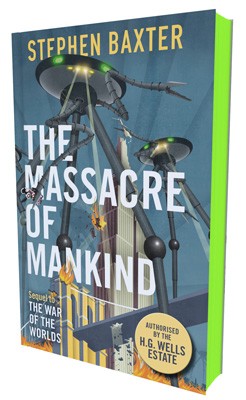
BOOK REVIEW: The Massacre of Mankind by Stephen Baxter

The Massacre of Mankind: Authorised Sequel to The War of the Worlds by Stephen Baxter
My rating: 2.3 out of 5


This review has a broad overview of the story so it may contain some minor spoilers.

In this, we have my most anticipated book of 2017, an authorized sequel to a foundation work of science fiction and one that I'd been waiting impatiently for since it was first announced. Within minutes of the ebook file being loaded onto my Kindle I was into it with great gusto, but after a few chapters, my level of enthusiasm had plummeted dramatically. I will say from the get-go that this book seems very well crafted in a technical sense, but Baxter's presentation makes me fearful that he may have made it largely inaccessible to a modern audience. Hopefully, during the course of this review, we can get to the bottom of why I feel this way.

The story idea is a great one, of course, in that the Martians invaders from the 1898 original novel The War of the Worlds come back to Earth to have another crack. This story begins in 1920 and is effectively an alternate history story with a sci-fi base. The book is stocked with plenty of characters from the original novel and the narrator of this book, Julie Elphinstone, is one of these.

The writer of The War of the Worlds, referred to within this book as "The Narrative", is named as a certain Walter Jenkins and it is his continuing obsession with the Martians and his predictions of their actions which drives this story forward. He commissions Julie to carry out a task for him to try to regain some control in the situation with the invaders. The military hijacks her mission and Julie is thrust headlong toward the Martian stronghold.

Much has changed in Britain and Europe after what after the events of the first Martian War, World War One has been fought but the outcome and resulting political landscape are very different. Britain is ruled by a corrupt military government in cahoots with Germany, who now control most of Europe. Some technology has been gleaned from the remnants of the Martians and this has been pressed into service in the form of mechanized weapons and there is a whole industry trying to harness the power of the atom.

Along the way, much is revealed of the Martian plans for their mission here on Earth. Also revealed are some other extraterrestrial species and these play various roles in the story. I must admit that this is an enjoyable element to the story that I didn't expect. Also enjoyable is the cool post-steampunk feel in places, like huge Zeppelins and massive armoured land-ships. The Martians eventually land on other parts of our planet as well and expand their assault. For much of the book, the story jumps between Julie's first-person account and various other third-person accounts from these other places.

The pace does pick up noticeably in the second half which is just as well because the first half is (I thought) annoyingly slow. Coupled with this, Baxter uses a language style which would be appropriate if it were written during the period in which it is set, but there is a large amount of time spent with needless descriptions of the scenes and the things in them. Maybe the author felt this old-school stuff necessary in order to achieve the desired period feel but it makes it really drag and I soon found it quite a chore to read. I can see a lot of people giving up on this part way through, which I nearly did a couple of times.

What kept me going was my desire to finish it, to see what happens in the end. Most of all, I really wanted to write a glowing review of this massively anticipated novel but, sadly, that isn't to be. If I'm really honest with you, I should've given up because I don't think that the conclusion of the story offered anything all that rewarding. It was okay in a thematic sense, but it wound down rather anticlimactically and left me feeling quite flat. The way is left open for continuation, there being a number of loose ends left dangling but, if there is, I don't think I will be leaping up to read it, not if it's anything like this book.

I'm certain that Mr Baxter put a lot of hard work into this book but I don't think that he or the publisher got this one right at all. That is only my opinion, of course, but it's not often that I feel as disappointed with a book as I have with this one.

4/5 for concept
1/5 for delivery
2/5 for entertainment
= 2.3 out of 5


24 July 2017

BOOK REVIEW: We Are Legion (We Are Bob) [Bobiverse #1] by Dennis E. Taylor

My rating: 4.6 out of 5

This is a fun read, a hard sci-fi story with a solid chunk of humor and cynicism that is a supremely enjoyable read. The writing style is excellent, flowing well and it works great within the realm of this story which is a multiple first-person account of self-replicating probes multiplying and exploring the galaxy. The style is similar to many other contemporary science fiction authors and it particularly reminded me of John Scalzi, a good thing because he is one of my favorite modern authors. Scalzi’s sarcastic wit is something to behold and Dennis E. Taylor seems to be cut from the same cloth in the story-telling sense anyway. I certainly encourage any Scalzi fan to give this a try.

I liked the central character Bob right from the outset, so when he becomes the essence of the artificial intelligence which controls an interstellar exploration probe I was more than happy to go along for the ride. The landscape of Earth, both geological and political, has changed dramatically over the hundred or so years between Bob’s death and his resurrection in a computer memory core, irreparably so and humanity is strongly motivated to find other options for survival. A number of groups and factions have the same idea of exploring space so Bob has his work cut out just to survive out in space let alone discover any inhabitable planets for humanity to relocate to.

As he goes, Bob is able to replicate himself to create additional probes as well as other more interesting hardware to aid his mission. It’s cool to see each new version of Bob take on it’s own personality, retaining much of their humanity along the way. I’ve not read anything to date that explores this post-physical existence in such a straight-forward and entertaining way. I know this is a reasonably common trope in science fiction, one that is very thought-provoking in the philosophical sense, but the way this book explores the idea is refreshing. It really is very nicely done. Also, there are plentiful references throughout to classic science fiction books and movies which will delight fans of the genre.

Out among the stars, our explorers discover lots of interesting things while searching for key resources which they require to resource their missions. Life is soon discovered and this is where the real highlight of the story is for me. Think Chariots of the Gods and ancient astronauts and you’ll get the basic idea of what goes on. To say much more will possibly introduce spoilers to this review, but I will say that the human-derived artificial intelligence becomes quite involved with a native species, exerting quite a bit of influence. Another nicely executed aspect.

Back at Earth, things are underway to try and get the remains of humanity and other species safely on their way to new homes. But, as one can expect, the human race continually exhibits their less desirable traits and the AI’s have their work cut out just to get people to agree on a plan. This brings me to another of the themes of the book (and a particular favorite of mine given my often general dislike of my own species) which is a commentary of humanity and those things that most intelligent people would agree that we must move beyond to achieve more of our potential. The book is full of cynical references to such things that any free thinker will probably relate to.

Overall, this is a well thought out and presented hard sci-fi story that I reckon any fan of such stuff will appreciate. It’s part of an ongoing series (three books at present) that has been very well received by readers and, after reading this, it’s easy to see why.

4/5 for concept
5/5 for delivery
5/5 for entertainment
= 4.6 out of 5


23 July 2017

BOOK REVIEW: Blood of the Cosmos (Saga of the Shadows #2) by Kevin J Anderson

My rating: 4.3 out of 5

Another great installment of this exciting space opera trilogy from one of the genre’s finest exponents. It continues the series immediately from where The Dark Between the Stars (my review HERE) left off, and gives further truck-loads of the same fast-paced action and bigness which are hallmarks of Anderson’s epic stories.

Like the previous books, for a kick off we’re given a decent story recap which is a great feature of the series, one of the key things which make these books so readable. You can come back into it after some time away and quickly pick up the story again, brought back up to speed with key events and plot elements that jog the memory sufficiently to enthusiastically get right back onto the roller coaster. That’s exactly what this series is, a fast-paced action science-fantasy space opera with most of the tropes that make this type of thing so appealing. It’s fantastic science fiction, full of the sense of wonder that the genre is famous for and there are so many things to help you get lost in it.

All of the familiar players return and many of them begin to take on larger roles in the story, which evolves at a breathtaking rate. We learn more about the dark and insane Shana Rei and their diabolical plan for the universe, aided still by the murderous Klikiss robots who are now seeing things for what they really are. The enigmatic Bloaters, the strange organic nodules found in deep space and abundant source of ekti-x stardrive fuel, remain an anomaly for the moment. A few more subtle clues are offered about their essence and I’m very eager to learn what these are all about. I’m anticipating something big from them. The background to many of the characters continues to be fleshed out, recounting much of what was presented in the Saga of Seven Suns which will further help readers who haven’t read that earlier series. The action is practically non-stop and I was always eager to return to the book after having put it down, always treated to something pretty good whenever I did. The world building is nothing short of spectacular.

The large science-fantasy elements to this story are superb; the magical realm of the Worldforest on Theroc with the trees’ instantaneous communications across the universe, facilitated by the fascinating green priests, the inter-dimensional and matter-manipulating abilities of the Shana Rei and the mind-bending Faeros who, along with the Hydrogues, are again going to play pivotal roles in the story. The Onthos aliens, who made their grand entrance at the end of book one, once tenders of another ancient worldforest, are sheltering on Theroc and take on a new more sinister role. Big things are going to happen with the worldforest and the green priests in book three.

As you can see, there really is so much going on in this story and I’m assuming that any reader of this would have at least read The Dark Between the Stars and maybe even the Saga of Seven Suns. If so they’ll know exactly what to expect. The large scale of the story makes this a superb escapism read and I usually found myself reluctant to “snap out of it” after a session in the pages. Huge marks for pure entertainment that’s for sure.

It’s looking like it’s going to be one hell of a climactic conclusion to the trilogy because the story is still building. I’m preparing myself for quite a ride in book three Eternity’s Mind. I highly recommend this book and series to lovers of space action and adventure. Sure, there are more “intellectual” space opera works out there, but for pure entertainment (which is exactly what this is intended to be) it cannot be beaten.

4/5 for concept
4/5 for delivery
5/5 for entertainment
= 4.3 out of 5


22 July 2017

BOOK REVIEW: Gift From The Stars by James Gunn

Gift From The Stars by James Gunn
My rating: 3.3 out of 5


Yeah, this was okay, actually quite a cool take on the alien first contact scenario where technical plans for some alien technology are discovered within an obscure UFO book. Some enlightened folk see these plans for what they really are and set about finding out the source of said plans and implementing them.

Each phase of the story is told in six novella length parts which were originally published individually. This is a format that I like and thought that it works well for this story which takes place over a number of years. The story itself is an easy read, especially the first few parts, but later parts are a little more involved and require more brain involvement by the reader. Especially when our space travelers enter some sort of inter-dimensional wormhole thing where time and space work a little differently. I thought that bit was great.

Book geeks will appreciate one character’s frequent references to well-known books and movies throughout the story. It kind of reminded me of…well…me, because I’m told that I often do this exact same thing a number of times during the course of the day.

In a nutshell this is an enjoyable but kind of plain hard sci-fi story that flows well and is therefore an effortless read, which is probably to be expected from an author of such caliber. It’s on the shorter end of the scale so I’d recommend it as a gap filler read in between bigger projects.

3/5 for concept
4/5 for delivery
3/5 for entertainment
= 3.3 out of 5


25 June 2017

BOOK REVIEW: Bluebirds: A Battle of Britain Novel by Melvyn Fickling

My rating: 4.7 out of 5
DISCLAIMER: I received a review copy from the publisher in exchange for an honest review.

I’ll cut straight to the chase and say that this is an excellent novel, no doubt about it. While not a new idea it’s a solid World War Two yarn full of the things that make fact-based war stories so fascinating to someone like me who has not had the misfortune of being involved in such events. It’s got superb action sequences which fully support the “meticulously researched” claim and it’s an excellent portrayal of the human aspects of war, the highs and lows and the sobering realities of how it affects people and their society.

As a kid, I remember being inspired by words from one of Winston Churchill’s stirring speeches:

We shall fight on the seas and oceans.
We shall fight with growing confidence and growing strength in the air.
We shall defend our island, whatever the cost may be.
We shall fight on the beaches.
We shall fight on the landing grounds.
We shall fight in the fields and in the streets.
We shall fight in the hills.
We shall never surrender!

The backdrop to these famous words and this story is England in 1940 when the British people are facing the prospect of Nazi invasion from across the English Channel. I’ve long had an interest in these events and is the main reason that I felt compelled to read it. I’m glad I did.


Central to the story are a group of young men and their families who answer the call and step up to face the Nazi menace. They come together as fighter pilots in the Royal Air Force during the hectic and dramatic days of the Battle of Britain. One of these chaps has made his way into RAF service from rural America and in the process becomes a poster boy for the British government as part of their efforts in trying to gain US government help in repelling the advancing Germans. To be fair, he is less than enthusiastic about his propaganda role and wishes to simply do his part in helping the people of Britain to defend themselves. Elsewhere, a pair of friends who are already serving pilots in an RAF fighter squadron watch as everything they have trained for suddenly becomes a reality. They witness early on over the beaches of Dunkirk the might of the Nazi war machine. They are like chalk and cheese in many ways yet share a bond that is forged in battle. Another key character, an unfortunate yet likeable lad raised in an abusive environment and who carries his demons with him right into the cockpit of a Spitfire. The characterization is one of the book’s stand out facets and overall there is a good mix of personalities which are all very real and believable. The author say in his notes that some of the characters are loosely based on real people which obviously lends itself to their authenticity.

The first third or so of the book is a real delight, introducing the main players as youngsters and giving the reader a nice look into how life was during the era, whether it be in rural America during the amazing barnstorming days of the 20’s & 30’s or in a quaint seaside village in England. As time progresses ominously toward World War Two, each of the main characters’ motivations for wanting to serve are well explored and I found myself relating to each one of them in one way or another. The depictions of the pre-war world are excellent, the descriptions of the locations and events are superb and it all combines to really put you right there in the time and place.

The remainder of the book is taken up with parallel wartime stories of the characters and eventually, they come together in the latter stages. Their battles are against more than just the Luftwaffe in the skies over England, for each has their own sideline life concerns or issues to contend with and, again, these are real-world and easy to relate to. The air combat sequences are excellent, being energetic and concise and there are lots of them. Actually, these are some of the best air combat scenes that I’ve read in a fictional work. The technical accuracy appears to be spot on too, the author obviously has done quite an amount of research or has some sort of first-hand knowledge. I can say this with a level of confidence due to my own reading of factual memoirs from people on both sides of the conflict such as Douglas Bader, Adolf Galland and Pierre Clostermann. The author must have drawn on similar first-hand accounts while compiling this tale. Top marks for that.

The text flows very well and the character dialogue is excellent. There is a modest amount of jargon but there is a glossary at the back of the book which explains the terminology. This was a nice help at times although the text is quite informative and there didn’t seem to be much necessity to refer to it. A tad confusingly, each chapter has a Latin singular word title and I had a little trouble in grasping their significance to the story because had to look up their meanings. I think that an English word would be of more use here, presenting the chapter’s point of emphasis more effectively. This is my only negative thought of the whole book which made it stand out to me all the more.

In summary, the story easily took me back the 70 or so years and is probably one of the best novels of this genre that I’ve read. Sure, it’s a story concept that is well-worn territory, yet it’s executed so well that it seemed somehow fresh. The promotional blurb says that this is the first in a series of historical novels, a thought which excites me if they’re going to be anything like this one. It would be cool to see a continuation story from this one, following key characters during their ongoing combat journeys. This is a great book to relax with and be reminded of how much was given and sacrificed, and that “never was so much owed by so many to so few”. A highly recommended read.

Concept: 4/5
Delivery: 5/5
Entertainment: 5/5
= 4.7 out of 5


17 June 2017

BOOK REVIEW: The Dark Between the Stars (Saga of the Shadows #1) by Kevin J. Anderson

My rating: 4.3 out of 5


When I saw this published I knew straight away that I’d need to read it having immensely enjoyed Anderson’s Saga of Seven Suns series a few years ago. This book is effectively a continuation of that series after a number of years have elapsed, and the first of a new trilogy of space opera novels called the The Saga of Shadows. Kevin J Anderson has a writing style that I love, his stories flow beautifully and this is no different – unsurprisingly.

seven-sunsIt’s nice to be immersed again in this universe, and for me particularly nice to go back to the forest world of Theroc, home of the sentient Worldforest and the green priests who are able to use worldtrees for instantaneous communication over seemingly infinite distances. I absolutely love Theroc and ever since first reading about it, has been one of my favorite fictional sci-fi locations. This planet is now the hub of human government in the Spiral Arm, after Earth and it’s moon have been badly damaged, and there is still a slightly uneasy alliance with the Ildirans. The Roamers, a loose confederation of independent humans, are still scattered about the place in often the most unusual places and the various splinter colonies of humans and Ildirans coexist together, but everyone is still recovering from the Elemental War from the earlier series. The various elemental beings from before are present in the story in varying degrees, some dormant and some quite visible and active. Also present as a major character is Rlinda Kett, my favorite from the last series, now a big-scale (in more ways than one) business woman with a large fleet of interstellar transport ships.

Essentially, it felt like coming home to a universe that I really enjoy being immersed in. Having said that, I don’t believe that a reader new to Anderson’s Seven Suns universe will be lost here, because he adds plenty of background information snippets to fill any storyline gaps that pop up occasionally. Over the first half of the book the story cruises along nicely, with the foundation being laid for what is surely going to be another epic tale. After that, things really bolt ahead and we get a glimpse at the direction that the series is going to take. Just as a major new turn takes place and we’re introduced to a new and ancient species in the galaxy, the book ends and leaves us hanging and happily waiting for the next book.

Yes, I enjoyed it a lot and I think that most fans of space opera will as well. It lacks a little of the depth of some other space opera epics, however, it’s a massively fun story and a very well written tale that kept me hooked at every point.

4/5 for concept
4/5 for delivery
5/5 for entertainment
= 4.3 out of 5


12 June 2017

BOOK REVIEW: Binary/System by Eric Brown

My rating: 4 out of 5


DISCLAIMER: Review copy from NetGalley.

If I imagine a 2017 version of a sci-fi magazine in the vein of golden-era publications such as Amazing Stories or If, then it would contain stories something like this one. I’ve referred to this pulp-fiction feel before in reviews of Brown’s work, and it’s a style that I find myself liking a lot. This is because there’s a big focus on the yarn for the sake of entertainment without too many words spent on character depth or excessive world-building. Much of Brown’s other work shows his prowess in those areas, but this one is about straight entertainment, pure and simple. It’s almost like Brown pours himself a stiff measure of his favorite liquor then sits down to write stories in his casual style that are meant to be fun, writing for his own entertainment as much as ours. This is a key reason why he’s one of my favorite authors and his books usually keep me firmly hooked because they’re so enjoyable. It’s an excellent reminder of why we read this sort of science fiction: it’s fun!

Somewhat confusingly, the first half of this book was released late last year simply titled Binary and now here is the complete novel which includes both that first half as well as a continuation from where it left off. The story follows Delia, a scientist from an ill-fated starship voyage who becomes marooned on an unknown planet in a binary star system over ten thousand light years from Earth. Her consequent adventures begin shortly after making planet-fall. The planet has a harsh and extreme protracted climate cycle and the alien inhabitants are in a continual state of inter-species conflict. She quickly becomes caught up in this conflict and forges friendships which introduce us to some likeable alien characters. These guys are interesting yet simplistic in their nature but this is certainly okay for the type of story which is probably more driven by events than characterization. None of the characters dominate or become a distraction to the overall plot which, again, lends itself nicely to the easy-reading style. The story concludes pleasantly yet leaves space for continuation which is a welcome thought.

The world building is likewise enjoyable, with excellent descriptions of things like alien cities and wondrous creatures featuring at various points in the story. This aspect is, in my view, this novel’s best feature and an aspect that makes this a fantastic escapist’s book. It’s what I think of as a great chill-out read that doesn’t tax your mind so much, yet keeps you involved with that sense of wonder that we all love in our science fiction stories, a facet that Eric Brown customarily does very well.

To be honest, the writing style seemed to me as if it was written with mostly a young adult audience in mind and, had it not been for the liberal use of lesser-known words (I consulted the dictionary multiple times) I would say that it would be most suitable for teenage readers. My nine-year old could probably read and enjoy this aside from the big words, but I suppose that’s a bit rich coming from me given that I needed the dictionary so often…

Overall the book works because of the effective use of some tried-and-true genre tropes blending together into a cohesive whole that makes a delightful read. It is equal parts adventure, drama and wonder, a combination that pulls the story along almost faster than you can keep up and provides a gratifying read. But keep up I did and discovered that Eric Brown has yet again failed to disappoint me with another entertaining story that was a real pleasure. If my descriptions match what you enjoy then I suggest that you’ll be as tickled as me by this uncomplicated and engaging novel. Give it a try.

Concept: 3/5
Delivery: 4/5
Entertainment: 5/5
= 4 out of 5