13 September 2018

BOOK REVIEW: Salvation (Salvation Sequence #1) by Peter F. Hamilton

My rating: 5 out of 5Like so many Peter F. Hamilton [PFH] readers, this has been my most anticipated release of 2018, so much so that I tried a number of channels to get hold of an advance reader copy. But, alas, my efforts were to no avail and I had to wait until the official release like most others. Was it worth the wait? My oath it was!

As a definite space opera and PFH fan, I was bound to sink my teeth into this one and most likely enjoy it. But, there's no undue bias here when I say that this book is simply superb. There's no other way to describe it and this new standalone series from PFH certainly looks like it's going to be another epic. The style in which it's written is very good, and typically PFH, and he didn't seem to get as bogged down in minutiae this time [as I feel much of his earlier work is affected]. All of the action and sub-stories are firmly part of the greater storyline, which is only just beginning to take shape in this book. The format is excellent, with numerous flashbacks and flashforwards from a central narrative, all of which link together and give you a hazy yet tantalizingly intriguing picture of where the story appears to be headed. It finished well and I am very excited to see where the series goes, this book being a good introduction to the universe and players before the story slips into a higher gear. Now tell me that doesn’t sound exciting.

To read, it felt a lot like a short story collection where the individual stories link together to form the framework of a larger tale, and this is pretty much what it is, each “chapter” giving a portion of the background, mostly about the key characters but also about the places and things within this new universe. As per usual, PFH’s world-building is second to none [ie. awesomely cool] and I found myself re-reading more than once some of his descriptions of locations and technology so that I could better grasp the wonder of it. Another hallmark of Hamilton’s fiction which is again present are lots of high-tech future cops and robbers and there’s no shortage of these in Salvation, with most of the central characters being some sort of police officer, security specialist, mercenary or criminal. The future flashforward sections are excellent, slightly reminiscent of other child or youth sci-fi soldier stories that you may have read, the characters struggling to come to grips with the knowledge that the future existence of mankind rests upon their shoulders. Overall, you can quite clearly how the different timelines relate to each other and how things might transpire.

Now we get to the part where I resist going into a breakdown of the story which would only add potential spoilers, but there are a number of excellent professional reviews online [like HERE and HERE]. What I can say that it is supremely entertaining and filled to the brim with good solid sci-fi action and intrigue. It’s space opera as it should be, a story painted on a canvas of galactic scale with an abundance of massive awesome stuff contained therein. There are interesting alien life-forms, interesting alien agendas and interesting alien technology, which is totally what you’d expect from PFH. Anybody who enjoys good sci-fi [and galaxy-spanning space opera in particular] will just devour this and love every moment of doing so. It’s a must for any PFH fan and also a perfectly suitable starting point for any readers new to his work. Hamilton has been shortening his novels a little in recent years and his work is much the better for it in my humble opinion, meaning that his work is probably that much more accessible for a mainstream audience. The earlier Night’s Dawn Trilogy, Commonwealth Saga and Void Trilogy books, while truly excellent books, were seen as a bit daunting by some readers. Such were my observations anyway. There are no such worries with this one, however, and it should be a thoroughly engaging and enjoyable read for a lot of people. Get into it.

5/5 for concept
5/5 for delivery
5/5 for entertainment
= 5 out of 5

Buy the ebook HERE (Amazon US)
Buy the paper book HERE (Book Depository UK)


18 August 2018

BOOK REVIEW: Thrawn: Alliances (Star Wars: Thrawn #2) by Timothy Zahn

My rating: 3.3 out of 5
Carrying on with this new canon series penned by sci-fi heavyweight Timothy Zahn, Thrawn: Alliances continues painting on the revised Star Wars canvas, feeling both familiar and completely new at the same time. There are a number of familiar characters [including the excellent and ever-present R2-D2] and places as well as many that we've not come across before. The storyline idea is familiar enough yet it is drifting gently and tangentially away from the traditional Expanded Universe ideas.

General Anakin Skywalker &
Commander Mitth’raw’nuruodo
The story of Admiral Thrawn's rise to power under the close observation of Emperor Palpatine is well covered in Thrawn [see my review HERE], and this book begins to flesh out the larger story of Thrawn's involvement with the Empire and why Palpatine finds him so interesting and useful. It is actually two completely separate but firmly linked stories in a then-and-now style, the book switching back and forth between these two timelines the whole way through. The "now" part is set during the height of the Empire when Emperor Palpatine senses a disturbance in the Force from the Unkown Regions and sends Thrawn and Darth Vader [who have a history of opposing each other in Imperial politics] off together in Thrawn's flagship Star Destroyer to discover the source of the disturbance. The "then" is set just after the Clone Wars and tells of how Thrawn [then a Commander in the Chiss Ascendancy military] and Jedi General Anakin Skywalker meet for the first time on a remote planet. They are on the trail of Senator Padmé Amidala who has gone chasing a lead relating to a secret Separatist rebel operation. It is this event that Thrawn himself refers to in book one when being questioned by the Emperor after his capture, he relays that he had met and fought with Jedi Skywalker and learned of the existence of the Galactic Republic [the precursor to the Empire]. He was told that Skywalker is dead, but Thrawn soon deduces that this may not be entirely true. Thrawn is a very intelligent and observant person and he has a fair idea of what's going on, whether it's Anakin and Padme's secret relationship [in the "then" story] or the true past identity of Darth Vader [in the "now" story] but keeps his cards close to his chest as he works the situation to his advantage. His love of art and culture often enables him to look at a scenario and make judgements that are surprisingly accurate. He's fast becoming one of my top favourite Star Wars characters.

Senator Padmé Amidala
The writing style is good and flows well, typical of an author of Zahn's pedigree, but the flavor of it came across as a little young adult to me, as if it has been purposely aimed at a younger reader. It felt more like a teen novel and would be enjoyed greatly by this segment I'd say. Zahn does a very good job of portraying Anakin's rash impetuousness and it was interesting to compare this to the similar traits in Darth Vader in the later storyline. This is obviously one of the things which help Thrawn deduce the truth, although unconfirmed at this stage of the game. To go much further into a recap of the story from what the synopsis already reveals would introduce spoilers, so I'll stop by saying that the storylines themselves are interesting enough and are very action-packed.

Like with Thrawn, I reckon the world-building is a tad modest but, again, I believe that the assumption has been made that the reader will already be familiar with the appearance of such things as a TIE fighter or a Stormtrooper, for example. I did find myself drifting a little at times and losing concentration, especially during some rather lengthy action and battle scenes and it was only when a particularly interesting new piece of information came along that I was snapped back to attention. Thankfully there are enough of these bits to keep me on the hook for the duration. I don't know what it is, but long action sequences have always been a bit of a bore for me, and this book [unfortuantely] has a few too many of them for my liking, some of the action seems quite trivial within the grand scheme. This is the book's weakest point in my view but, if you like lots of action, then you'll probably love it and think I'm an idiot [you won't be the first...].

One of the most interesting parts is a fresh new approach to a traditional Expanded Universe [now Star Wars: Legends] idea of invaders from outside the galaxy [ie. the Yuuzhan Vong] and I'll wager that this is going play a large part in the story arc moving ahead. Quite exciting, this is. I'm still not fully settled on how I feel about the tangential shift and the new direction that Star Wars is taking, and this book [and the latest Disney-era movies] are clearly designed more for a new audience without a lot of prior experience with the traditional Star Wars plots. I think that as time progresses the new canon will become the norm and all will be in balance once more. In the meantime, there is obviously more to come with this story arc [word on the street is that Zahn has been contracted for a third novel in the series] which I am looking forward to, especially finding out more about these potential invaders from the Unknown Regions.

In summary, it's an okay book but I didn't enjoy it anywhere near as much as the first book of the series. It's clear that the planning people are using these new books to build the foundation for a much larger Star Wars story from which to branch out into other mediums [ie. movies and TV] and, for that reason, this book and series are necessary reads for those who wish to stay abreast of the new canon themes. A recommended read for the fan but not all that gripping in a general sense.

4/5 for concept
3/5 for delivery
3/5 for entertainment
= 3.3 out of 5

Buy the ebook HERE (Amazon US)
Buy the paper book HERE (Book Depository)


04 August 2018

BOOK REVIEW: Outpost (Donovan Trilogy #1) by W. Michael Gear

Outpost (Donovan Trilogy #1) by W. Michael Gear
My rating: 4.7 out of 5

I've been seeing this title [the first of a planned trilogy] pop up on a few book blogs that I keep an eye on, the synopsis immediately catching my attention, sounding like an interesting far-flung space colony story set on a planet with weird and wonderful ecology which is resisting human attempts to plunder resources from their home. The colony is on the planet Donovan which is thirty light-years away and the colonization and mining operations are being overseen by a ruthless profit-driven corporation based back in our Solar System. The strange thing is that the last half-dozen Corporation ships that have attempted to make the journey to Donovan have all disappeared, leaving the colonists stranded and left to their own devices. That is until the ship Turalon, which carries a high-level member of The Corporation board, finally makes orbit. It's crew prepares to head planetside to find out what's been going on over the last few years.

Down on Donovan they discover a failed colony with the government overthrown, the few colonists who are left having gone rather feral. This is quite understandable because the planet has presented a number of challenges, mostly the strange and often deadly flora and fauna which is constantly trying to kill them. When The Corporation, along with a squad of Marines, attempts to re-establish their power they are in for a shock because the Donovan colonists have reorganized themselves into a dysfunctional yet effective group who are [only just] surviving despite what the planet throws at them. Toss into the mix a few characters who have agendas of their own and you get a really engaging and interesting plot. The story follows the political and physical tussle in superb detail, with stacks of action and great dialogue all wrapped up some very good world-building. The creatures on the planet are simply awesome, especially the huge almost dragon-like quetzals, nemesis of the colonists and who I expect are going to play a much larger role in the ongoing story. The cover is slightly misleading in that the structure of human bones pictured [while definitely present in the story] is not really a major plot element in an overall sense. But, maybe I'm wrong? Or have I missed a crucial clue somewhere along the way? I thought that the cover art was not the best choice as an indicator of the story content.

As I read through, I was often reminded of the movie Avatar which has a similar vibe, the planet and what it holds being more than initially meets the eye, and also the struggle against a huge corporate power. The world building in this book is just as good and I often found my mind's eye thinking on the same scale, reminded of the fantastic imagery of the movie. Think of this as a good thing, unless you thought that Avatar was rubbish, which will mean that you might find some aspects of this book tiresome. Not me though, I loved it and I'm really looking forward to book two of this Donovan Trilogy called Abandoned which is due for publication in November 2018. Overall this sci-fi adventure is great entertainment which ticked all of the boxes for me in what I look for in a novel these days.

4/5 for concept
5/5 for delivery
5/5 for entertainment
= 4.7 out of 5

Buy the ebook HERE (Amazon US)
Buy the paper book HERE (Book Depository)


12 July 2018

BOOK REVIEW: From a Certain Point of View [Star Wars]

From a Certain Point of View [Star Wars] by Various Authors
My rating: 4.3 out of 5
Okay, how about a fresh new anthology of forty short stories telling the Star Wars: Episode IV A New Hope story from a multitude of different perspectives, written by some of the biggest names in contemporary sci-fi literature? Yep, bring it to me! The idea of this simply demanded that I give it a solid look. Also, it is written to sit within the new Disney canon structure which is another reason why I wanted to give it a try, that is to see how the new ideas people treated this grass-roots Star Wars plot (which kicked off one of the biggest entertainment franchises of all time) and how it stacked up against the traditional story and ideas that I grew up with. So how does it rate? Quite okay as it turns out.

The story is a well-known one but, if you'll indulge me, let's recap briefly [deep breath...]: A couple of droids, one of which [R2D2] belongs to a beautiful young princess and Rebel leader [Leia Organa] contains the stolen plans (recently portrayed in Rogue One: A Star Wars Story) to an Imperial space station and super-weapon [the Death Star]. The droids are pursued across space and the arid planet Tatooine by thousands of shiny white Stormtroopers and a shiny black Sith Lord [Darth Vader] to stop the plans getting into the hands of the Rebel forces. Whilst on Tatooine they team up with an old Jedi Knight [Obi-Wan Kenobi] (who is watching and protecting a young boy [Luke Skywalker] from a distance) and a couple of smugglers [Han Solo and Chewbacca] who have a very fast freighter vessel [the Millenium Falcon] which can get the droid and the stolen plans past the Imperial blockades to the secret Rebel base [on Yavin 4]. The Death Star plans contain details of a certain vulnerability which the Rebels hope to exploit and destroy it before it can be moved into position to destroy the Rebel base in a gigantic race against time. Numerous scenes are told from the point of view of often minor [however, not all are "minor",  i.e. Obi-Wan, Yoda and Boba Fett] characters who give us a refreshing new view of the events. Even from these new perspectives, the story is satisfying and the climax is fantastic.

Dianoga
Mon Mothma
There's no denying that the stories themselves are of great quality, written by some of the best of the genre; authors like Ken Liu, Chuck Wendig, Pablo Hidalgo and Paul S Kemp [and others] require no introduction to most and produce some top work in these pages. There are only a few exceptions at either end of the scale, there are two pieces that I didn't care for at all, but the vast majority are real beauties. It's difficult to nail down particular favorites, but two that did stand out for me included one told from the point of view of a sentient force-sensitive water creature called a dianoga which is what Leia, Luke, Han and Chewie encounter in the watery trash chamber on the Death Star, while the other tells of [Rebel leader] Mon Mothma's secret contingency plans in the event of a Rebel defeat if that were to happen. These were fascinating insights. Like I said, apart from a couple, all are great reads.

I'm very glad that I picked this one up because it was a real treat to read. From what I've now read a few titles produced from the new Disney/Lucasfilm/Del Rey combination and have been quite impressed with the quality of the work. While I'm still not totally confident in the overall story direction going forward compared to the traditional [now called "Legends"] ideas, the literature which I've seen so far seems to be tracking along nicely. This compilation sat well with me and I would bet that most Star Wars fans will enjoy these fresh insights into the established A New Hope story. A highly recommended read for anyone into the Star Wars saga, even if they've only got a basic understanding of the overall storyline. Now, if the brains trust who oversee this whole project could just lift their game a little when it comes to the new movies, that would be good.

4/5 for concept
4/5 for delivery
5/5 for entertainment
= 4.3 out of 5

Buy the ebook HERE (Amazon US)
Buy the paper book HERE (Book Depository)


10 June 2018

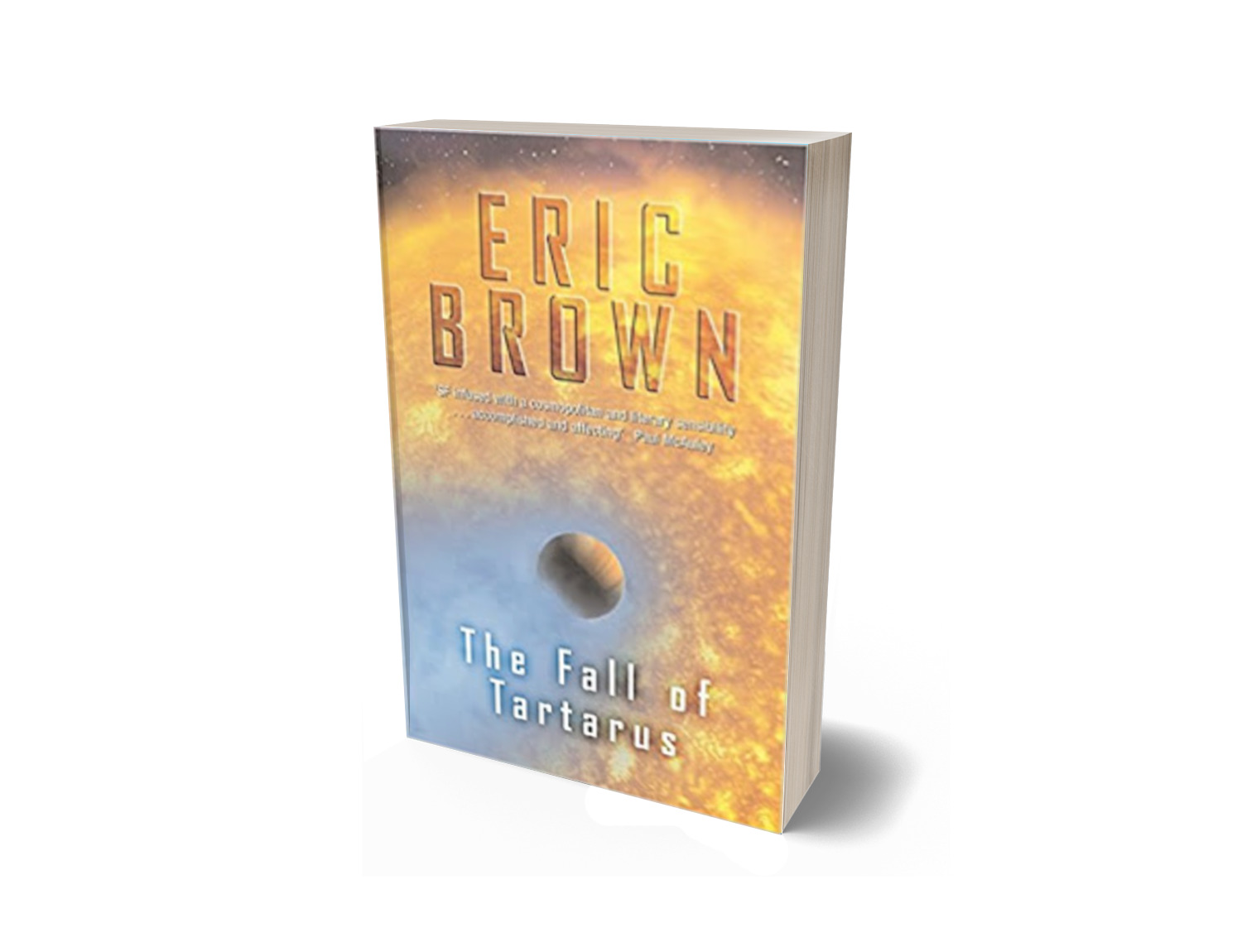
BOOK REVIEW: The Fall Of Tartarus by Eric Brown

My rating: 5 out of 5
Somewhere within every review that I write of Eric Brown's work usually appears a statement that he has [yet again] failed to disappoint me and this collection of eight interlinked short works is yet another superb example of this. This book showcases an author who writes consistently good science fiction and the stories overflow with so many of the ingredients which make up supremely entertaining yarns. The main character is the planet Tartarus whose sun is going nova (a cataclysmic eruption and subsequent decline of a star) and each story is about characters who are either live on the planet or are returning for various reasons. The stories are arranged chronologically, with each one set closer to the impending supernova, from a couple of hundred years prior right up until the supernova engulfs Tartarus and those left there. Each story was originally published in sci-fi magazines between 1995 and 2000 and one of the stories, the novella Hunting The Slarque, won the British Science Fiction Association’s best short story award in 2000, a fact which doesn't surprise me one little bit.

The first story Destiny on Tartarus tells of a young man who travels to Tartarus to find out the fate of his father and is a fantastic journey across the planet where we see some truly amazing sights. This story culminates in a very dangerous boat race in the planet's fiercest waters and this is where our main character learns what he came to the planet to discover. A hugely fun yarn that was a pure joy to read.

Next is A Prayer for the Dead which is another retrospective beauty where the main character revisits his childhood home on Tartarus and reminisces about his childhood and the events that occurred over one particular period. Superb characterization and an interesting ending really make this one what it is.

The Eschatarium at Lyssia tells the story of an artist who lost his wife on Tartarus and is asked by a messenger from the planet claiming to have been sent by his [living] wife who wishes to see him again. Disbelieving, he still goes back to the planet and when he revisits an ancient structure created millions of years ago by a mysterious alien race, he finds the answer to this questions and makes some startling discoveries. Reasonably short, it gives us more good characters and a personal and emotional story.

In The Ultimate Sacrifice, we follow a reporter who goes to Tartarus to find her lost brother or to find out the fate he has suffered. She's lead to the Church of the Ultimate Sacrifice where adherents practice a form of mortification in an attempt to appease the God of the supernova. It reveals more details of religion on Tartarus and is very interesting with a bittersweet ending.

The People of the Nova tells a story of an official on Tartarus who is trying to find a native tribal people in order to evacuate them before to the supernova. This story that looks at the rights and wrongs of forcing people to abandon their home planet and has plenty of feeling and emotion mixed in.

Next up, Vulpheous is another excellent story with a bittersweet finish. The main player here is hunting to kill the last existing member of a rare sea-elephant-like species called the Vulpheous. He believes that the animal's liver may hold the key to cure to many currently incurable diseases. He meets a native girl who has also trekked to the Vulpheous in order to find a different cure for herself, one which requires the animal to be alive. Conflicting emotions and dilemmas ensue, as you can imagine.

Hunting the Slarque tells the fascinating story a man who was a victim of an attack on Tartarus (he was actually killed) by what is believed to be a Slarque, a devolved intelligent species thought by many to be extinct. His remains were placed in stasis which then underwent a "regeneration" procedure funded by a wealthy businessman in return for assistance in capturing a Slarque for his zoo. This has a really interesting finish where the story elements come together really nicely.

Finally, Dark Calvary reintroduces the Church of the Ultimate Sacrifice and also reveals more details of the Slarque and the relationship between these two. The ending is superb and is a fitting finale to both this story collection and the planet of Tartarus itself.

In summary, this compilation shows that Eric Brown can't write bad stories, well I'm yet to read one. I'm left feeling satisfied and complete from reading these stories, each one fitting within Brown's tried-and-true formula which has amazing locations and events along with the character themes of loss, love, sacrifice and redemption. These ingredients really make the stories shine, just like just about every other piece of Eric Brown's work that I've read so far. I couldn't recommend this one any higher.

5/5 for concept
5/5 for delivery
5/5 for entertainment
= 5 out of 5

Buy the ebook HERE (Amazon US)
Buy the paper book HERE (Amazon UK)

26 May 2018

BOOK REVIEW: Project 77 by Martin Deschambault & Jeffrey Campbell

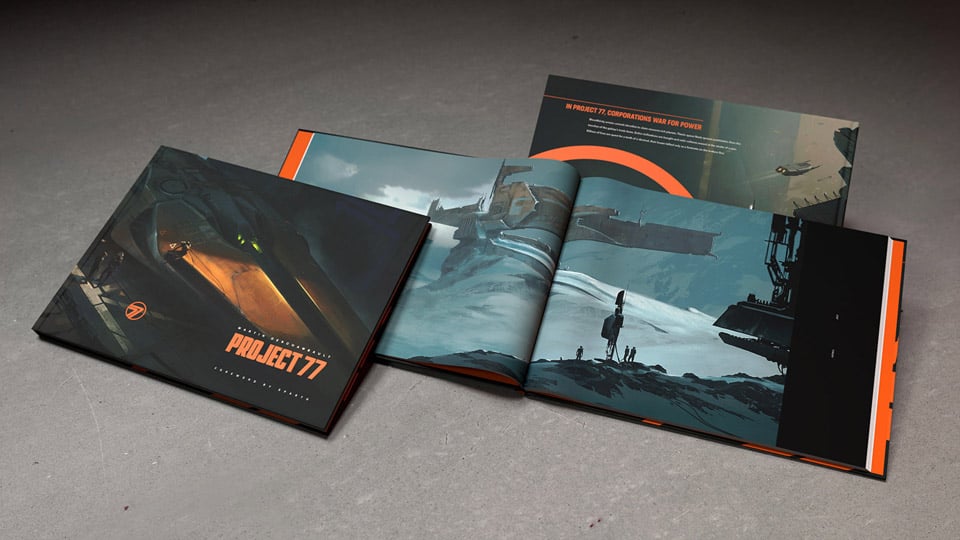
Project 77 is a collaboration between extremely talented professional artist Martin Deschambault and the publishing division of ArtStation, a showcase platform for games, film, media and entertainment artists. The quality of the artwork is second to none, to say the very least, the pieces merging together superbly giving the reader a tantalizing glimpse into a supremely fascinating universe. It's a sci-fi space opera displayed in great artistic detail and interlinked by nine interesting [very] short stories from Jeffrey Campbell. Each of the 300 - 400 word short stories give further details of some of the artworks which depict a certain story facet, whether it be a place, an event or one of the characters. I'm left quite impressed by the experience of being immersed in so many awesome pictures. The potential of the story framework is enormous and it will be interesting to see how far this project goes.

It has a theme which is very dystopian in style, set in the far future where monstrous corporations are at war with one another, the bounty being the vast resources of the galaxy. These organizations have assembled massive armies and fleets of spaceships to procure those resources and ensure that their investments are kept secure. Because of this, entire civilisations are traded and cultures are erased at the stroke of a pen, their losses being nothing more than a minor inconvenience. Within this society crime is rife, lubricating the gears of commerce with smugglers, assassins, pirates, bounty hunters and saboteurs lining up to cash in on the endless corporate warfare. It's a bleak society seemingly devoid of any hope for the average man, yet the stories hint at something about to change, a faint spark of faith and expectation which may ignite the fire of rebellion against the corporations. Each of the pieces, whether art or story fragment, show only a very small part of the story yet by the time I reached the end of the book I was positively brimming with enthusiasm for the concept. We are shown amazing future cities, technology and machines, alien worlds and creatures, as well as many rather cool bio-mechanical hybrids. I found myself staring at many of the pictures for some time soaking up what they have to offer, the art coming alive with motion in my mind's eye the longer I spent being immersed in them. The influence of popular culture sci-fi, especially Star Wars, is noticeable but this doesn't impede in any way on the project's originality. At the end of the book, Deschambault provides half a dozen tutorials, insights into his process of creating some of the art pieces. Even though I'm very much a non-artist, I still found these quite interesting and especially so his explanations of what he was trying to convey in the picture in terms of a story or idea.


Reading this is a new experience for me and one which I enjoyed very much, but I can't really compare this book to anything that I've read in recent years. The closest thing that I've experienced would have to be the old 1980s Terran Trade Authority illustrated science fiction books that I enjoyed as a teenager. It was my fondness for these that convinced me to look at Project 77 in the first place. There's something very captivating about good artwork and stories that complement each other and Project 77 is a good example of this. My only [very minor] complaint is that I wish that the written stories were longer and told a more complete tale, rather than just providing a morsel of a larger story. But, these brief fragments piqued my curiosity enough to want to know more, and I'd have to say that they're very well written for the word count available. To be fair, this book is really about the art and the stories are there to support that, something that they do very well.

This is clearly only the very beginning of a much larger story journey and just a portion of the current Project 77 artwork appears in this volume. Deschambault is already hinting at volume two, which something that I'm immediately enthusiastic about. If you're into sci-fi and fantasy art or feel like you'd like to try something a little different in a sci-fi book, I can recommend Project 77 wholeheartedly.

In the meantime, check out Deschambault's incredible work at ArtStation HERE.

5/5 for concept
4/5 for delivery
5/5 for entertainment
= 4.6 out of 5

Buy the book HERE (Amazon)


28 April 2018

BOOK REVIEW: Pelquin's Comet by Ian Whates

My rating: 4.7 out of 5


English author Ian Whates has been around for a while now as a publisher, editor and author and I've been meaning to give one of his offerings a crack for some time, especially since he has been responsible for publishing stories from a few of my firm favourite sci-fi writers like Peter F. Hamilton & Eric Brown. Based on this, I naturally assumed that maybe Whates has the same good taste as me (IMHO) and finally sought out some of his own work. What caught my eye first was Pelquin's Comet, a shortish novel and the first in a (so far) two-part series called The Dark Angels. It turns out that it's a bloody good story, spinning my wheels up pretty good and arousing my imagination wonderfully because it's brimming with many solid sci-fi tropes and elements.

Right from the start, Whates gets you thinking, and you just know that you're in for some twists and turns. That's exactly what you get, a medium-to-fast paced story with fun and interesting characters and a plot that keeps you thinking right to the very last page - just my sort of thing. It's a fun ride, travelling faster-than-light with the crew of the small trading ship Pelquin's Comet under the command of the rather full-of-himself Captain Pelquin. The ship is crewed by a stereotypical bunch of rogues who come together to form an efficient crew, their intention to make as much money as possible from their various ventures cavorting around the galaxy. In this story, we're taken on a quest to acquire a cache of ancient technology left behind by the Elders – an advanced civilisation which seemed to have abandoned the galaxy centuries ago. The Elders, no doubt (and hopefully), will play a much larger role in the greater story arc, as will many of the key characters.

Pelquin requires a considerable loan from a bank to facilitate the recovery mission, which he is able to secure, but not without Drake who is one of the bank's agents (along with his unique and more-than-meets-the-eye alien companion), tagging along for the ride. Also added to the crew of the Comet as a stand-in engineer is Leesa, a woman who does not even know who she really is herself. What becomes clear early on, is that these two, as well a few others who pop up along the way, are a whole lot more than who they initially appear to be. We're given glimpses into their somewhat nefarious pasts which I assume will become much clearer as the series moves forward. The book comes to a satisfactory conclusion but it probably askes more questions than it answers and requires you to seek out the next book in the series The Ion Raider for more. The action is good, not too graphic yet gritty enough for a story such as this and pretty much perfect for a general audience. My only genuine critical observation would be that I found myself now and then wanting to see a little bit more of the various locations that are visited in the story. But the world-building is still more than adequate, the author no doubt saving the word count for the guts of the story.

The combination of fun and intriguing plot, effective characterization and an easy flowing style makes this a very entertaining read. It's a boisterous space romp between the stars and I'd recommend it to anybody who enjoys solid grass-roots sci-fi to be immersed in and chill out with. That's my purpose for reading books like this much of the time and why I enjoyed it so much.

4/5 for concept
5/5 for delivery
5/5 for entertainment
= 4.7 out of 5

Buy the ebook HERE (Amazon)
Buy the paper book HERE (Book Depository)


20 April 2018

FREE DOWNLOAD! Thud Ridge by Jack Broughton [EPUB & PDF]

Due to the generosity of some avid book enthusiasts you can now download an electronic version of the excellent Vietnam war memoir Thud Ridge by Col. Jack Broughton (see below). This book is no longer in print either in paper or ebook form, so this is a great opportunity to get yourself a copy.


This is the story of a special breed of warrior, the fighter-bomber pilot; the story of valiant men who flew the F-105 Thunderchief 'Thud' fighter-bomber over the hostile skies of North Vietnam.

DOWNLOAD: epub pdf

Book details (from Wikipedia):


The book is based on Broughton's tour of duty between September 1966 and June 1967 as Vice Commander of the 355th Tactical Fighter Wing, based at Takhli Royal Thai Air Force Base, Thailand. The narrative is anecdotal in nature, a commentary of his observations of persons, aircraft, and events during his tour, more or less chronologically, but without dated references. Few individuals are identified by other than first or nicknames, but Broughton develops most as characters through descriptions of their career backgrounds. Broughton's accounts of missions "up north" were enhanced in both accuracy and verisimilitude by verbatim transcriptions of radio transmissions he recorded using a small tape recorder mounted in the cockpit of his aircraft.


In Thud Ridge Broughton is highly critical of the U.S. command structure directing air operations against North Vietnam. He blames micromanagement by the highest levels in Washington down to the Thirteenth Air Force, a command echelon based in the Philippines, for losses of men and aircraft that he characterizes as "astronomical" and "worthless". He is particularly critical, however, of the "bomber mentality" management by generals who came up through the Strategic Air Command and then occupied key command slots in the war, which was being fought by pilots of the Tactical Air Command.


The book came about when, at the completion of his tour of duty, Broughton and two of his pilots were court martialed by the USAF for allegedly conspiring to violate the rules of engagement regarding U.S. air operations. Although acquitted of the most serious charges, Broughton, who had been personally relieved of duty by Pacific Air Forcescommander Gen. John D. Ryan, was subsequently transferred to an obscure post in the Pentagon, allegedly as a vendetta because his punishment was so slight. Required by office protocol to work only two or three days a month, he used both his extra time and his bitterness at the Air Force to compose Thud Ridge while he awaited approval of an application to appeal of his conviction to the Air Force Board for Correction of Military Records.


After his conviction was overturned and expunged from his record because of "undue command influence", Broughton retired from the Air Force in August 1968 and had the memoir published by J.B. Lippincott. The book appeared soon after as a Bantam paperback, with reprint editions in 1985, 2002, and 2006.


Click HERE to check it out on Goodreads.