11 November 2014

BOOK REVIEW: Devourer by Liu Cixin

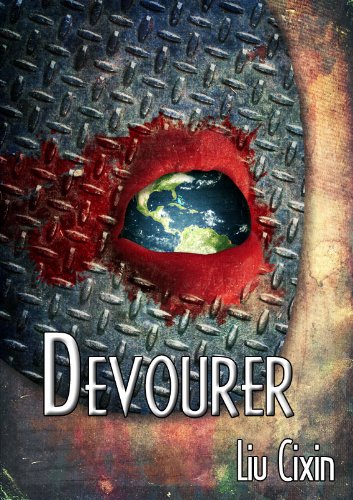
Devourer Devourer by Liu Cixin
My rating: 4 of 5 stars

A crystalline structure floating through the depths of space bears tidings of destruction: “The Devourer approaches!”

Countless cables, thousands of miles long, are lowered from the Devourer's inside wall to the Planet's surface below. An entire world is trapped, like a fly in the web of a cosmic spider. Giant transport modules are then sent back and forth between earth and Devourer, taking with them the planet's oceans and atmosphere.


This short novel is a real gem, it's a fun and thought provoking read from an interesting and obviously skilled Chinese author. It's been translated beautifully because there were no hints of translation at all that I could detect. The story details themselves are relatively standard sci-fi ideas, but it's the 'human' aspect that impressed me, and Liu presents humanity interestingly in the light of the alien invaders. I was a little reminded of the work of John Scalzi and his Old Man's War universe novels, mainly by the dialogue and philosophical ideas, and I mean this as a huge compliment. Overall a solid story that I really recommend to any sci-fi reader.

View all my reviews


24 October 2014

How To Be An Effective Liar

Lying is considered a bad thing, but ask anyone to justify a lie that they’ve told and they probably can. When and where you should lie is your call, but if you have to do it here’s how to do it effectively...


18 October 2014

BOOK REVIEW: The Abyss Beyond Dreams by Peter F. Hamilton

The Abyss Beyond Dreams: A Novel of the CommonwealthThe Abyss Beyond Dreams by Peter F. Hamilton
My rating: 5 of 5 stars

The year is 3326. Nigel Sheldon, one of the founders of the Commonwealth, receives a visit from the Raiel—self-appointed guardians of the Void, the enigmatic construct at the core of the galaxy that threatens the existence of all that lives. The Raiel convince Nigel to participate in a desperate scheme to infiltrate the Void.


Once inside, Nigel discovers that humans are not the only life-forms to have been sucked into the Void, where the laws of physics are subtly different and mental powers indistinguishable from magic are commonplace. The humans trapped there are afflicted by an alien species of biological mimics—the Fallers—that are intelligent but merciless killers.


Yet these same aliens may hold the key to destroying the threat of the Void forever—if Nigel can uncover their secrets. As the Fallers’ relentless attacks continue, and the fragile human society splinters into civil war, Nigel must uncover the secrets of the Fallers—before he is killed by the very people he has come to save.


----- --- -------

Outstanding. There's not really another word for this book. Being a huge fan of the Commonwealth Saga and the Void trilogy, this went straight to the top of my reading list. And what a book! The story is built inside the same amazing universe as those previous works, but new readers will not struggle either, as Hamilton has created an entirely new story thread and provides enough background information to support it if you have not read the other Commonwealth Saga books. There's been some debate as to whether you can approach this book as a stand alone or if you'd be better served reading the previous Commonwealth books. I think that you could, and this is what the author intended. Actually set before the events of the Void trilogy, Nigel Sheldon is commissioned by the Raiel to be transported inside the Void to attempt to find out it's secrets. What he discovers is amazing, and the story that follows is wonderful and a full-on page-turner. I devoured this book effortlessly, because the plot and writing are so good. Actually, I found it easier to read than any other Peter F Hamilton novel that I've read previously, but I'm not sure if it was just the wonderful story or something about his style that did it. The story gallops along at a enjoyable pace and the plot gradually twists itself up enough to set up for the second book in the series nicely, but at the same time reaching a satisfying conclusion. This is a fantastic novel that clearly demonstrates Hamilton's wonderful talent. He's one of the best. Read it, you won't be disappointed.


----- --- -------
View all my reviews


12 October 2014

Science Has Great News for People Who Read Actual Books


It's no secret that reading is good for you. Just six minutes of reading is enough to reduce stress by 68%, and numerous studies have shown that reading keeps your brain functioning effectively as you age. One study even found that elderly individuals who read regularly are 2.5 times less likely to develop Alzheimer's than their peers. But not all forms of reading are created equal.

The debate between paper books and e-readers has been vicious since the first Kindle came out in 2007. Most arguments have been about the sentimental versus the practical, between people who prefer how paper pages feel in their hands and people who argue for the practicality of e-readers. But now science has weighed in, and the studies are on the side of paper books.

Read about why HERE over at mic.com

11 October 2014

Introverts - we're not wierdos

introvert
noun
1. a shy person.
2. Psychology a person characterized by concern primarily with his or her own thoughts and feelings (opposed to extrovert).

Being very much toward the introvert end of the scale, I wish everyone knew this...


22 September 2014

BOOK REVIEW: The Dark Between the Stars by Kevin J. Anderson

The Dark Between the StarsThe Dark Between the Stars by Kevin J. Anderson
My rating: 4 of 5 stars

Twenty years after the elemental conflict that nearly tore apart the cosmos in The Saga of Seven Suns, a new threat emerges from the darkness. The human race must set aside its own inner conflicts to rebuild their alliance with the Ildiran Empire for the survival of the galaxy.


Galactic empires clash, elemental beings devastate whole planetary systems, and factions of humanity are pitted against each other. Heroes rise and enemies make their last stands in the climax of an epic tale seven years in the making.


"It has been twenty years since the events of The Saga of the Seven Suns, in which an ancient war among four elemental races is reignited and nearly destroys both the human race and the alien Ildirans. The new Confederation has governed human civilization across its many colonized planets since the end of the Elemental War, and relations between the humans and Ildirans are harmonious. Peace and commerce have been restored, with the Roamers back in the business of mining and selling the valuable stardrive fuel ekti (required for faster-than-light travel) and the green priests of Theroc providing instantaneous trans-galactic communication via their sentient worldtrees. But the malevolent Klikiss robots are plotting their revenge from exile, and soon find an ally in the ancient Shana Rei, the destructive personification of darkness and chaos which has awakened from millennia of slumber to destroy all sentient life in the universe."
--http://en.wikipedia.org/wiki/The_Saga_of_Shadows


When I saw this published I knew straight away that I'd need to read it having immensely enjoyed Anderson's Saga of Seven Suns series a few years ago. This book is effectively a continuation of that series after a number of years have elapsed, and the first of a planned trilogy of space opera novels called the The Saga of Shadows. Kevin J Anderson has a writing style that I love, his stories flow beautifully and this is no different - unsurprisingly. It's nice to be immersed again in this universe, and for me particularly nice to go back to the forest world of Theroc, home of the sentient Worldforest and the green priests who are able to use worldtrees for instantaneous communication. I absolutely love Theroc and ever since first reading about it, has been one of my favorite fictional sci-fi locations. This planet is now the hub of human government in the Spiral Arm, after Earth and it's moon have been badly damaged, and there is still a slightly uneasy alliance with the Ildirans. The Roamers, a loose confederation of independent humans, are still scattered about the place in often the most unusual places and the various splinter colonies of humans and Ildirans coexist together, but everyone is still recovering from the "Elemental War" from earlier. The various elemental beings from before are present in the story in varying degrees, some dormant and some quite visible and active. Also present as a major character is Rlinda Kett, my favorite character from the last series, now a large scale (in more ways than one) business woman with a large fleet of interstellar transport ships. Essentially, it felt like I was coming home to a universe that I really like being immersed in. Having said that, I don't believe that a reader new to Anderson's Seven Suns universe will be lost here, because he adds plenty of background information snippets to fill any storyline gaps that pop up occasionally. Over the first half of the book the story cruises along nicely, with the foundation being laid for what is surely going to be another epic tale. After that, things really bolt ahead and we get a glimpse at the direction that the series is going to take. Just as a major new turn takes place and we're introduced to a new and ancient species in the galaxy, the book ends and leaves us hanging and happily waiting for the next book. Yes, I loved it and I think any fan of space opera will. It lacks some of the depth of some other space opera epics 
(like Hamilton's Commonwealth Saga/Void Trilogy), and for this reason it missed out on it's fifth star from me. However, it's a massively fun story and a very well written tale that kept me hooked at every point.

View all my reviews


14 September 2014

The World Map we all know is WRONG

We have been misled by an erroneous map of the world for 500 years!


The Gall–Peters area-accurate world map

01 September 2014

BOOK REVIEW: The Contact Episode Two by Albert Sartison

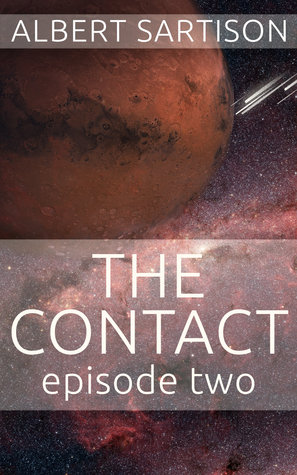
The Contact Episode TwoThe Contact Episode Two by Albert Sartison
My rating: 4 of 5 stars

The ascendancy of mankind is being decided on Jupiter 

In the 22nd century, mankind assimilated the Solar System within the orbits of the inner planets, and was gradually moving further out, beyond the asteroid belt, onward towards the outer planets. 

The recently discovered technology of remote manipulation gave people the capability of altering the orbit of celestial bodies of planetary size, which laid the foundation of a new era for the human race: the terraforming age. The colonization of space beyond the limits of the Solar System became only a matter of time. 

Soon after the first successful test, changing the orbit of Mercury, a strange object moving from the depths of space towards the centre of the Solar System entered the field of vision of a telescope at an observatory in Chile…


Another solid four star installment of this nicely progressing story. We get some action in this one and it's not bad, and the plot makes a more dramatic turn. The steady ramping up of the story is good, and the action scene gives a quick blip in the pace before settling back into the familiar descriptive and informative hard sci-fi style. I particularly enjoyed the author's depiction and description of the medical procedures happening in the automated medical complex on the ship. I normally would gloss over such things but it is obviously well written because I liked it. I was however a little frustrated at the author's use of the word 'turbines' to describe his spaceship engines. I can't imagine that a turbine engine (ie. mechanically-driven compressor and/or propshaft) would be found on a space vehicle flying in the vacuum of space 200 years in the future. Surely a 'nuclear fusion generated plasma jet' or something along those lines would be more likely? Anyway, a minor point that does not detract from this fun read.

View all my reviews