Anyone who follows my book reviews will know beyond any doubt that Eric Brown is one of my all-time favorite authors of any genre. Eric writes some of the easiest to read and entertaining science fiction stories that I've yet to find and he is equally adept at the shorter forms just as he is with novels. He's also moving more and more these days into crime stories and this has become a successful spin-off from his sci-fi work.

Seeking escapism and inspiration...from books & stuff
Showing posts sorted by date for query eric brown. Sort by relevance Show all posts
Showing posts sorted by date for query eric brown. Sort by relevance Show all posts
15 March 2019


25 February 2019
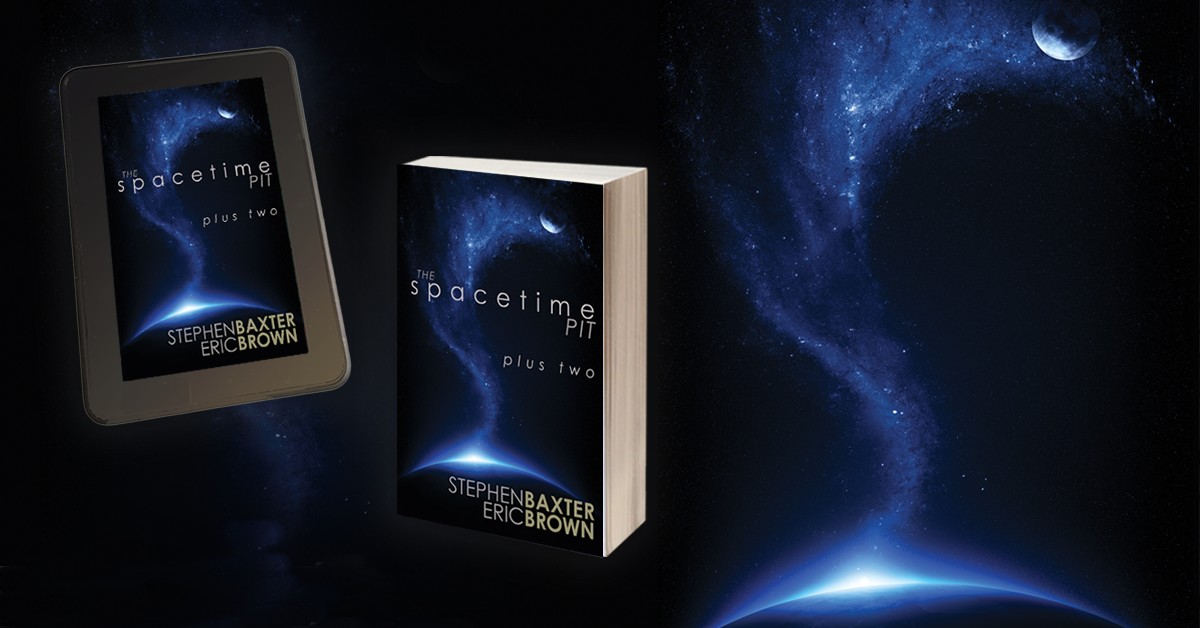
The Spacetime Pit Plus Two by Stephen Baxter & Eric Brown

In the award-winning The Spacetime Pit, spacer Katerina Wake crash-lands on a primitive alien world and faces certain death unless she can harness her ingenuity, and technical know-how, to bend the destiny of an entire race to her will...
Green-Eyed Monster follows Richard as he wakes up after a night on the tiles to find himself inhabiting the body of a toad – and that's just the start of his troubles...
In Sunfly, Onara and her people live on a world very different from our own – a vast ribbon encircling a sun. But a change is coming to the land, a mysterious narrowing that threatens not only the stability of her world, but the very order of everything she has taken for granted.
***** *** *******
What a gem of a collection this is! Mind you, I shouldn’t be surprised given that the three stories contained in this book are a collaboration between two of Britain's best sci-fi authors. They are quick reads which flow very well, testament to the skill of their creators. Both Baxter and Brown will need no introduction to readers familiar with contemporary sci-fi literature, and anybody new to or exploring the genre should really have a look at this as a fine sample of their work. Apparently, according to Brown in the Introduction, The Spacetime Pit began when he and Baxter met to work on some ideas back in 1995 after which it won the 1996 Interzone magazine readers’ poll for best story. This success obviously encouraged them to continue working together on stories whenever time would permit and I'm exceedingly glad that they did because it's a really good piece of work. In summary, this is an excellent little collection that is a quick yet superbly enjoyable read. I can think of no better way than to spend a couple of hours on a lazy afternoon. Anyway, I shall wax lyrical no more, so here is a quick rundown of the stories:
NOTE: I always try not to, but there's the possibly of some minor spoilers ahead (but no plot giveaways) so don't read on if you’re sensitive to such things.
The Spacetime Pit
Eric Brown himself describes this as "a grim tale that spans billions of years, but has the dilemma of a human being at its very core" which is a perfect description. An explorer of a world one hundred light-years from Earth becomes marooned and has to think creatively to try and get herself off the planet and back up to the orbiting station in which she is based. She has a survival pod which enables her to enter extended periods of total stasis and she uses this ability in her attempt to create a situation in which she can recover from her predicament. The world-building in here is excellent and the style used is slick and easy to follow.
My rating: 4.5/5
Green-Eyed Monster
A more humorous story here, largely told from the point of view of a toad (yes, an actual toad). In a nutshell, a chap experiences through a bit of alien intervention, "bodily transmogrification" and sees his life and surroundings from a series of new perspectives. I enjoyed this one mostly due to the sheer unusual nature of it and also for how human the story was - even from the point of view if a toad. The ending is great. A nice lighthearted story that will make you chuckle occasionally.
My rating: 4/5
Sunfly
I rate this as the real jewel of the collection, absolutely wonderful as a quick absorbing read with a great "sense of wonder" element that drew me in deeply right from the first words. Set on a huge ring-world type structure which is facing impending and catastrophic change, it's a journey of discovery for the main character as she discovers truths about the amazing world on which she lives. This one felt like classic Eric Brown and this is no doubt the main reason why I connected with it and enjoyed it so much. Brown has a real knack with this type of story and those of you familiar with his work will have an idea of what I'm talking about. If you like Brown's work, you will enjoy this. Heck, you'll enjoy it even if you've never heard of either Brown or Baxter, it's a fine sci-fi adventure with a good conclusion. An excellent story.
My rating: 5/5
Total Rating:
= 4.5 out of 5

23 October 2018
BOOK REVIEW [Reblog]: Salvage by Eric Brown
A couple of days ago I was asked by a friend for some advice on what sci-fi book they should pick up next. I asked them what they'd like to read and the answer was "something entertaining and interesting yet not too long or involved." Salvage was one of the first books to pop into my head, and the more we discussed what it is that they like, became more and more a match. I'm happy to report that they are loving it so far, just as I thought they would.
Anyway, this prompted me to reblog a short review which I did a few years back:
***** *** *******
My rating: 4.7 out of 5

Synopsis:
When Salvageman Ed saves Ella Rodriguez from spider-drones on the pleasure planet of Sinclair’s Landfall, he has no idea what he’s letting himself in for. Ella is not at all what she seems, as he’s soon about to find out.
What follows, as the spider-drones and the Hayakawa Organisation chase Ed, Ella and engineer Karrie light-years across space, is a fast-paced adventure with Ed learning more about Ella – and about himself – than he ever expected.
The Salvageman Ed series of linked stories – four of which appear here for the first time – combine action, humour and pathos, from the master of character-based adventure science fiction.
----- --- -------
This is the first short story collection of Brown's that I've read. It's a group of stories that are all linked together by the characters and the general 'journey' of the stories, similar to Kethani which is another collection of his stories that blend together into a fine novel length book.
Salvage reads great and has a really fun 'pulp sci-fi' feel going on that I totally loved. At times I was reminded almost of some old Perry Rhodan stories that I've read in years gone by but with a little more finesse. There are all the elements there for great stories - FTL starships, robots, AI, aliens, weird and wonderful planets and species. The lot.
The use of words to describe people, places and things is absolutely fantastic and made me chuckle at times. I used the dictionary feature on my ebook reader a number of times for some of the more impressive words. Check out a couple of examples:
“They left the prison of the flesh, which by any definition is finite, and became immortal. They reside now in a realm of their own devising, free of the corruption of the physical, a hundred million of them in a virtual universe tied in a way I can barely comprehend to the nano-strings that bind the quantum universe. Their new home might very well last forever.”
and just for a giggle:
The creature said, raising itself on its multiple limbs, “I thank you for your hospitality, my friends, and now I must repair to my berth and void the excess of foodstuffs partaken. Good night to you.”
I love this stuff, right good yarns with heaps of well-proven sci-fi tropes and ideas all done in a fun and hugely entertaining way. Overall a great little book that, once again, confirms Eric Brown as one of my all-time favourite authors. I'd like him to do more work like this. Highly recommended.
4/5 for concept
5/5 for delivery
5/5 for entertainment
= 4.7 out of 5
Buy the ebook HERE (Amazon)
Buy the paper book HERE (Book Depository)
10 June 2018
BOOK REVIEW: The Fall Of Tartarus by Eric Brown
My rating: 5 out of 5
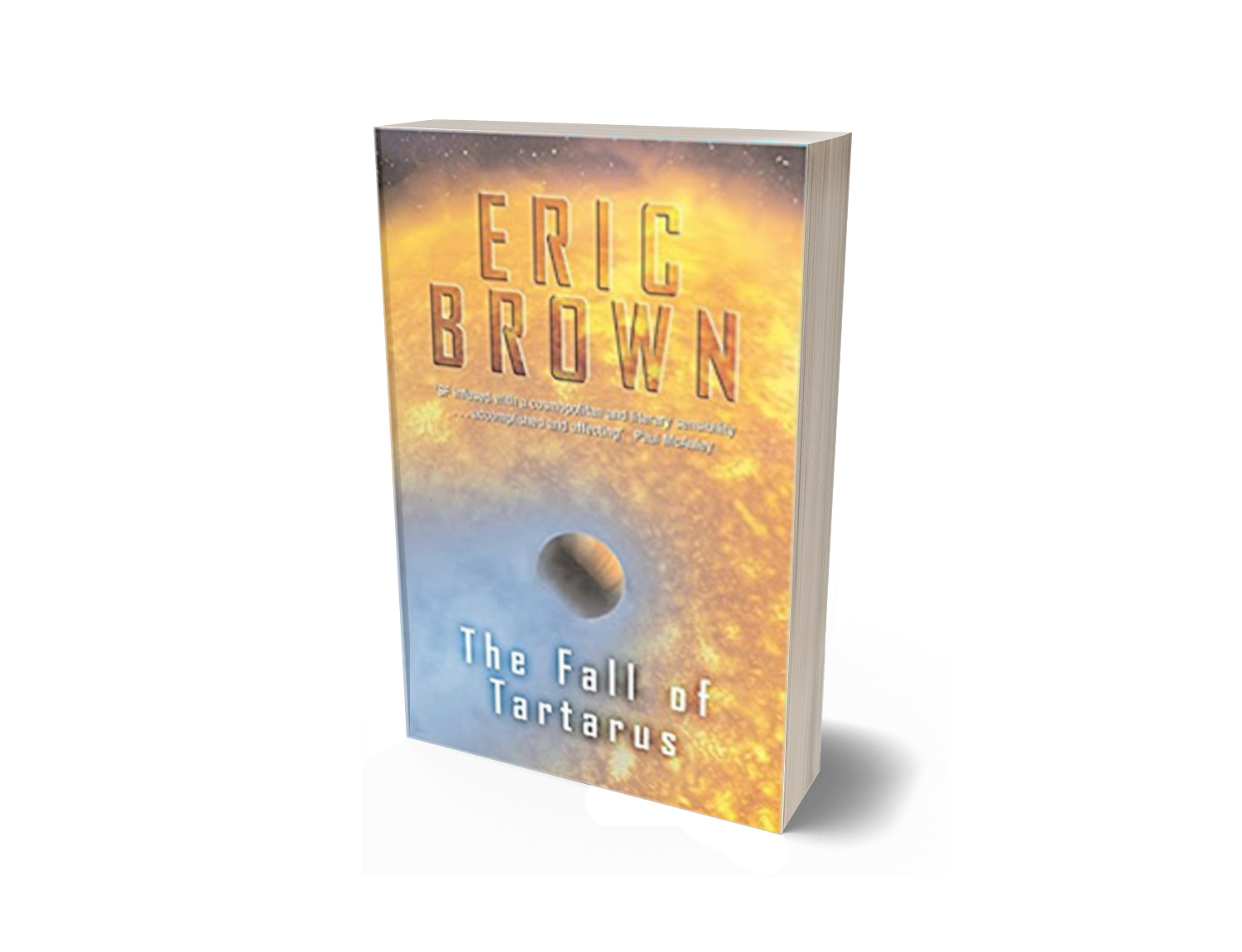
The first story Destiny on Tartarus tells of a young man who travels to Tartarus to find out the fate of his father and is a fantastic journey across the planet where we see some truly amazing sights. This story culminates in a very dangerous boat race in the planet's fiercest waters and this is where our main character learns what he came to the planet to discover. A hugely fun yarn that was a pure joy to read.
Next is A Prayer for the Dead which is another retrospective beauty where the main character revisits his childhood home on Tartarus and reminisces about his childhood and the events that occurred over one particular period. Superb characterization and an interesting ending really make this one what it is.
The Eschatarium at Lyssia tells the story of an artist who lost his wife on Tartarus and is asked by a messenger from the planet claiming to have been sent by his [living] wife who wishes to see him again. Disbelieving, he still goes back to the planet and when he revisits an ancient structure created millions of years ago by a mysterious alien race, he finds the answer to this questions and makes some startling discoveries. Reasonably short, it gives us more good characters and a personal and emotional story.
In The Ultimate Sacrifice, we follow a reporter who goes to Tartarus to find her lost brother or to find out the fate he has suffered. She's lead to the Church of the Ultimate Sacrifice where adherents practice a form of mortification in an attempt to appease the God of the supernova. It reveals more details of religion on Tartarus and is very interesting with a bittersweet ending.
The People of the Nova tells a story of an official on Tartarus who is trying to find a native tribal people in order to evacuate them before to the supernova. This story that looks at the rights and wrongs of forcing people to abandon their home planet and has plenty of feeling and emotion mixed in.
Next up, Vulpheous is another excellent story with a bittersweet finish. The main player here is hunting to kill the last existing member of a rare sea-elephant-like species called the Vulpheous. He believes that the animal's liver may hold the key to cure to many currently incurable diseases. He meets a native girl who has also trekked to the Vulpheous in order to find a different cure for herself, one which requires the animal to be alive. Conflicting emotions and dilemmas ensue, as you can imagine.

Hunting the Slarque tells the fascinating story a man who was a victim of an attack on Tartarus (he was actually killed) by what is believed to be a Slarque, a devolved intelligent species thought by many to be extinct. His remains were placed in stasis which then underwent a "regeneration" procedure funded by a wealthy businessman in return for assistance in capturing a Slarque for his zoo. This has a really interesting finish where the story elements come together really nicely.
Finally, Dark Calvary reintroduces the Church of the Ultimate Sacrifice and also reveals more details of the Slarque and the relationship between these two. The ending is superb and is a fitting finale to both this story collection and the planet of Tartarus itself.
In summary, this compilation shows that Eric Brown can't write bad stories, well I'm yet to read one. I'm left feeling satisfied and complete from reading these stories, each one fitting within Brown's tried-and-true formula which has amazing locations and events along with the character themes of loss, love, sacrifice and redemption. These ingredients really make the stories shine, just like just about every other piece of Eric Brown's work that I've read so far. I couldn't recommend this one any higher.
In summary, this compilation shows that Eric Brown can't write bad stories, well I'm yet to read one. I'm left feeling satisfied and complete from reading these stories, each one fitting within Brown's tried-and-true formula which has amazing locations and events along with the character themes of loss, love, sacrifice and redemption. These ingredients really make the stories shine, just like just about every other piece of Eric Brown's work that I've read so far. I couldn't recommend this one any higher.
5/5 for concept
5/5 for delivery
5/5 for entertainment
= 5 out of 5
Buy the ebook HERE (Amazon US)
Buy the paper book HERE (Amazon UK)
28 April 2018
BOOK REVIEW: Pelquin's Comet by Ian Whates
My rating: 4.7 out of 5

Right from the start, Whates gets you thinking, and you just know that you're in for some twists and turns. That's exactly what you get, a medium-to-fast paced story with fun and interesting characters and a plot that keeps you thinking right to the very last page - just my sort of thing. It's a fun ride, travelling faster-than-light with the crew of the small trading ship Pelquin's Comet under the command of the rather full-of-himself Captain Pelquin. The ship is crewed by a stereotypical bunch of rogues who come together to form an efficient crew, their intention to make as much money as possible from their various ventures cavorting around the galaxy. In this story, we're taken on a quest to acquire a cache of ancient technology left behind by the Elders – an advanced civilisation which seemed to have abandoned the galaxy centuries ago. The Elders, no doubt (and hopefully), will play a much larger role in the greater story arc, as will many of the key characters.
Pelquin requires a considerable loan from a bank to facilitate the recovery mission, which he is able to secure, but not without Drake who is one of the bank's agents (along with his unique and more-than-meets-the-eye alien companion), tagging along for the ride. Also added to the crew of the Comet as a stand-in engineer is Leesa, a woman who does not even know who she really is herself. What becomes clear early on, is that these two, as well a few others who pop up along the way, are a whole lot more than who they initially appear to be. We're given glimpses into their somewhat nefarious pasts which I assume will become much clearer as the series moves forward. The book comes to a satisfactory conclusion but it probably askes more questions than it answers and requires you to seek out the next book in the series The Ion Raider for more. The action is good, not too graphic yet gritty enough for a story such as this and pretty much perfect for a general audience. My only genuine critical observation would be that I found myself now and then wanting to see a little bit more of the various locations that are visited in the story. But the world-building is still more than adequate, the author no doubt saving the word count for the guts of the story.
The combination of fun and intriguing plot, effective characterization and an easy flowing style makes this a very entertaining read. It's a boisterous space romp between the stars and I'd recommend it to anybody who enjoys solid grass-roots sci-fi to be immersed in and chill out with. That's my purpose for reading books like this much of the time and why I enjoyed it so much.
4/5 for concept
5/5 for delivery
5/5 for entertainment
= 4.7 out of 5
Buy the ebook HERE (Amazon)

24 January 2018
BOOK REVIEW: The Telemass Quartet by Eric Brown
The Telemass Quartet by Eric Brown
My rating: 4.3 out of 5
My rating: 4.3 out of 5

Here we are again, examining a really nice body of work from one of my all-time favorite genre authors, one who repeatedly fails to disappoint me with his ability to spin splendid yarns that are interesting, entertaining and a pure joy to sit back and relax with.
The Telemass Quartet is a series four separately published novella length stories that are chronological and really need to be read as such:
1. Famadihana on Fomalhaut IV
2. Sacrifice on Spica III
3. Reunion on Alpha Reticuli II
4. Exalted on Bellatrix 1
You could possibly read numbers 1 through 3 in any order, but definitely number 4 should be read last as it is a finale and concludes the series nicely. I read them one after the other as a single work which worked very well, the overall storyline has good momentum which I enjoyed staying with.
Set in the same universe as Brown's Starship Seasons series of novellas in what we know as "the expansion”, the Telemass stories have a similar vibe and feel, being very character based with love, loss, pain and eventual joy the key elements. It's a flavour of story that Brown is very, very good at and it has become a real signature of his work. This bundle is a blast to read, and tells the story of tired ex-cop Matt Hendrick from Earth who wishes to get his daughter back from his ex-wife who has kidnapped her and is undertaking a quest across the galaxy in search of dramatic healing for her. Each installment has a race of strange and enigmatic aliens and some sort of cult or bizarre spiritual practice central to the story. These are tropes that Brown has used in previous books and are ones that always combine together to deliver an interesting story.
The first installment, Famadihana on Fomalhaut IV, introduces the main players and takes us on a journey to a remote jungle planet where a strange religious cult and race of aliens enact rituals in an attempt to bring the dead back to life. As you can expect, all is not as it seems. Next, in Sacrifice on Spica III, we go to a planet that is just about to begin a brutal five year winter, slowly closing down and its inhabitants retreating far underground to await the arrival of summer. Here we find another bizarre cult with death at its core. Then, in what I thought was the most interesting of the series, Reunion on Alpha Reticuli II takes place on a luxury tourist planet that is awaiting the arrival of a starship which has been travelling for centuries to reach the planet. The thing here is that after the starship left Earth, instantaneous Telemass travel was invented and rendered starship travel obsolete and others from Earth beat them there by a few hundred years. The crew of the starship are unaware of this until they phase back into normal space. This part only forms part of the backstory to the main plot which is still Hendrick’s quest to reclaim his daughter. Reunion really sets things up for the finale by introducing a key character who plays a pivotal role in the end. Speaking of which, Exalted on Bellatrix 1 is the final installment and brings about a fitting finish to the tale. Again, there is a strange alien species and a group of humans who have an unusual relationship with them. It is these aliens and their abilities who are able to effect a fine end to the overall Telemass storyline.
Each novella follows the same general theme and they flow together very well. If the whole lot were bundled together end to end, it would make up a nice novel, and that is effectively how I read it. This has happened with some Eric Brown’s previous work and has turned out very well - Brown’s own Kethani being a good example of individual short works combining to become a great novel.
Overall, this series comes together very well and is an enjoyable read. I spent much of my time reading this with either a cup of coffee or glass of cider next to me, depending on the time of day. Perfect. It doesn’t break any new ground but fans of Eric Brown will find comfort in his trademark style and character development. For anyone who is new to Brown’s work, this series would be a fine introduction, in my opinion. I suspect we may see this released as a single volume in the near future, as well as seeing more stories based in this interesting Telemass universe. I love the sound of that.
4/5 for concept
5/5 for delivery
4/5 for entertainment
= 4.3 out of 5


12 June 2017
BOOK REVIEW: Binary/System by Eric Brown
My rating: 4 out of 5

DISCLAIMER: Review copy from NetGalley.
If I imagine a 2017 version of a sci-fi magazine in the vein of golden-era publications such as Amazing Stories or If, then it would contain stories something like this one. I’ve referred to this pulp-fiction feel before in reviews of Brown’s work, and it’s a style that I find myself liking a lot. This is because there’s a big focus on the yarn for the sake of entertainment without too many words spent on character depth or excessive world-building. Much of Brown’s other work shows his prowess in those areas, but this one is about straight entertainment, pure and simple. It’s almost like Brown pours himself a stiff measure of his favorite liquor then sits down to write stories in his casual style that are meant to be fun, writing for his own entertainment as much as ours. This is a key reason why he’s one of my favorite authors and his books usually keep me firmly hooked because they’re so enjoyable. It’s an excellent reminder of why we read this sort of science fiction: it’s fun!
Somewhat confusingly, the first half of this book was released late last year simply titled Binary and now here is the complete novel which includes both that first half as well as a continuation from where it left off. The story follows Delia, a scientist from an ill-fated starship voyage who becomes marooned on an unknown planet in a binary star system over ten thousand light years from Earth. Her consequent adventures begin shortly after making planet-fall. The planet has a harsh and extreme protracted climate cycle and the alien inhabitants are in a continual state of inter-species conflict. She quickly becomes caught up in this conflict and forges friendships which introduce us to some likeable alien characters. These guys are interesting yet simplistic in their nature but this is certainly okay for the type of story which is probably more driven by events than characterization. None of the characters dominate or become a distraction to the overall plot which, again, lends itself nicely to the easy-reading style. The story concludes pleasantly yet leaves space for continuation which is a welcome thought.
The world building is likewise enjoyable, with excellent descriptions of things like alien cities and wondrous creatures featuring at various points in the story. This aspect is, in my view, this novel’s best feature and an aspect that makes this a fantastic escapist’s book. It’s what I think of as a great chill-out read that doesn’t tax your mind so much, yet keeps you involved with that sense of wonder that we all love in our science fiction stories, a facet that Eric Brown customarily does very well.
To be honest, the writing style seemed to me as if it was written with mostly a young adult audience in mind and, had it not been for the liberal use of lesser-known words (I consulted the dictionary multiple times) I would say that it would be most suitable for teenage readers. My nine-year old could probably read and enjoy this aside from the big words, but I suppose that’s a bit rich coming from me given that I needed the dictionary so often…
Overall the book works because of the effective use of some tried-and-true genre tropes blending together into a cohesive whole that makes a delightful read. It is equal parts adventure, drama and wonder, a combination that pulls the story along almost faster than you can keep up and provides a gratifying read. But keep up I did and discovered that Eric Brown has yet again failed to disappoint me with another entertaining story that was a real pleasure. If my descriptions match what you enjoy then I suggest that you’ll be as tickled as me by this uncomplicated and engaging novel. Give it a try.
Concept: 3/5
Delivery: 4/5
Entertainment: 5/5
= 4 out of 5

08 April 2017
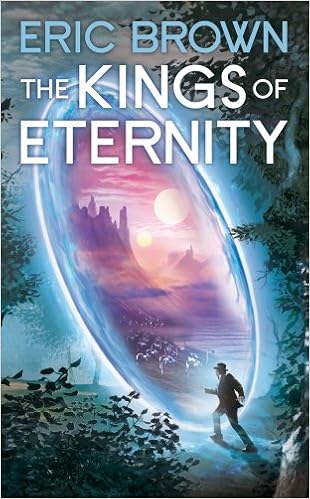
BOOK REVIEW: The Kings of Eternity by Eric Brown
My rating: 4.6 out of 5
This is a review that I find a little difficult to write, which may seem strange for a book to which I’ve given a good rating, but as I begin to write I’m struggling to put down in words how much enjoyment I got from this. Therefore it’s probably going to be a rather short review.
This is a review that I find a little difficult to write, which may seem strange for a book to which I’ve given a good rating, but as I begin to write I’m struggling to put down in words how much enjoyment I got from this. Therefore it’s probably going to be a rather short review.
Good enough to make it onto my own personal all-time favorites list, I’ve not read a book quite like it. While this is a great science fiction book written by one of today’s finest authors of any genre (in my humble opinion) it actually starts out quite different (i.e. non-sci-fi) and it’s not until a little way through that the science fiction elements appear. But when they do, it’s in a really cool way, in stark contrast to the 1930’s England in which a portion of the story is set, and this is one of the things that makes this book so wonderful.
The story is told from two quite different viewpoints, one a first person account, the other a third person narrative and they combine along the way into a solid story of happiness and pain, wonder and intrigue. To say much more would probably introduce spoilers, and the synopsis probably tells as much as you need to know, so hopefully it’s sufficient enough to say that the story is told superbly and that it left me feeling very satisfied, glad that I’d invested the time reading it.
If I was forced to make comparisons, some books that I’ve read that are similar are some of Eric Brown’s other works, namely Kethani and The Serene Invasion. All of these stories have at their core some sort of benevolent alien species that can bestow wonderful yet ominous gifts upon human recipients. Like those other books, this book presents the human aspect of such wonders, how one might begin to adjust to a life of no disease or sickness and even immortality when we’re bred and conditioned to expect finite time with sickness as a fact of life. I very much wanted to be one of the characters in this book, I connected with it on such a level.
To avoid simply rambling on about how good this book is and how much enjoyment that Brown has given me yet again, I’m going to close with my usual appraisal of his work: once again Eric Brown fails to disappoint.
A must-read for any lover of story.
Concept: 4/5
Delivery: 5/5
Entertainment: 5/5
= 4.6 out of 5

29 September 2016
BOOK REVIEW: Binary by Eric Brown
 Binary by Eric Brown
My rating: 4 of 5 stars
On what should have been a routine mission to the star system of 61 Cygni A, Delia Kemp finds herself shunted thousands of light years into uncharted space. The only survivor of a catastrophic starship blow-out, Delia manages to land her life-raft on the inhospitable, ice-bound world of Valinda, and is captured by a race of hostile aliens, the Skelt. What follows is a break-neck adventure as Delia escapes, fleeing through a phantasmagorical landscape.
As the long winter comes to an end and the short, blistering summer approaches, the Skelt will stop at nothing to obtain Delia’s technical knowledge – but what Delia wants is impossible: to leave Valinda and return to Earth.
---- --- ------
Yep, as I thought: I enjoyed this very much. A "half-novel" in that it is the first installment of a two-part story that will be published next year as a single volume. It is quite typical of Brown's more recent sci-fi stories which have a distinctive pulp feel. I've mentioned this before in other reviews of Brown's work, and it's a style that I find myself liking a lot. There's more of a focus on the yarn and not so much on depth of character or world-building, etc. Many of Brown's other works show his prowess in those areas, but this one is pure fun. The story follows a scientist as she becomes marooned on an unknown alien world and her adventures there. The planet and the aliens are interesting without becoming a distraction to the overall, and rather simple, plot. The whole thing works because of some well used tropes and overall it blends together into a cohesive whole that is a satisfying read. It's what I think of as a great bedtime read that doesn't tax your mind but keeps you interested with a sense of wonder which is a facet that Eric Brown does so well.
----- --- -----
View all my reviews

10 August 2016
BOOK REVIEW: Starship Coda (Starship Seasons #5) by Eric Brown
 Starship Coda (Starship Seasons #5) by Eric Brown
My rating: 4 of 5 stars
Ten years after events depicted in Starship Spring, David Conway is enjoying life on the idyllic world of Chalcedony, Delta Pavonis V. Then he receives a communique from his ex-wife who reveals that she is undergoing a remarkable medical process. Not only that, but she is coming to Chalcedony and wishes to meet him. What follows will force Conway to look back at the tragic events of his past and face the mendacity of those seeking to gain from his fame as an Opener of the Way. Starship Coda is the moving epilogue to the successful Starship series.
----- --- --------
This short story is exactly as the name suggests, a concluding event, a summation of the Starship Seasons series of novellas. While probably not vital or essential to the series, it nonetheless provides fitting closure to the main background story of the main character David Conway. If you've read the Starship Seasons stories then you'll love this and it'll provide you with an additional measure of satisfaction for what is an excellent series. I have to say it, Eric Brown fails to disappoint me again.
----- --- -------
View all my reviews

08 August 2016
BOOK REVIEW: Starship Spring (Starship Seasons #4) by Eric Brown
 Starship Spring (Starship Seasons #4) by Eric Brown
My rating: 5 of 5 stars
“That year, a little over six years since meeting Hannah van Harben, life for me was just about as good as it could get.”
David Conway is happily married with a young daughter, and wants for nothing. He has an idyllic life on the colony world of Chalcedony, with friends Matt and Maddie, Hawk and Kee – but things are about to get interesting when the friends holiday at Tamara Falls on the planet’s equatorial plateau. Buried far beneath the Falls is a dormant alien army – the Skeath, ancient enemies of the Yall: an army which is threatening to come to life, if the evil Dr Petronious gets his way… Starship Spring is the triumphant conclusion to the Starship Quartet.
----- --- ------
This is the fourth adventure in the excellent Starship Seasons series of novellas from one of my all-time favorite authors. This one is another typical example of Eric Brown's work, and epitomizes what is (to me) some of the most fun and relaxing sci-fi to read. Like the other stories in the series, as well as much of his other work, this novella is written in Brown's great easy and sort of pulp style that I love so much, and this lends itself to the delivery of a fun read that I find myself quickly absorbed into.
In Starship Spring, we again join David Conway and his likeable band of friends on the planet Chalcedony for another adventurous journey of intrigue and discovery. The story skips briskly along as you'd expect from the previous stories and has a fine conclusion, with plenty of alien wonder and intrigue. Character depth is fine for the type of stories that these are, and the world building is excellent once again.
Each of the novellas could be read as a standalone story without any real problem, but the events do follow a timeline and loose thread that would be best picked up from Starship Summer which is the first story of the series. This has been a fabulous little series of stories and takes Brown yet another step up the ladder in my author rankings. I see that recently there has been a coda for the series released and I have just purchased said story that will no doubt top off one of the best group of easy sci-fi stories that I've read to date.
----- --- -------
View all my reviews

20 June 2016
BOOK REVIEW: Helix Wars (Helix #2) by Eric Brown
 Helix Wars by Eric Brown
My rating: 3 of 5 stars
Helix Wars, sequel to the best-selling Helix is a fast-paced adventure novel about the ultimate threat to the Helix itself and to humanity, whose role it is to protect it.
The Helix: a vast spiral of ten thousand worlds turning around its sun. Aeons ago, the enigmatic Builders constructed the Helix as a refuge for alien races on the verge of extinction.
Two hundred years ago, humankind came to the Helix aboard a great colony ship, and the Builders conferred on them the mantle of peacekeepers. For that long, peace has reigned on the Helix. But when shuttle pilot Jeff Ellis crash-lands on the world of Phandra, he interrupts a barbarous invasion from the neighbouring Sporelli - who scheme to track down and exterminate Ellis before he can return to New Earth and inform the peacekeepers.
Helix Wars, sequel to the best-selling Helix, is a fast-paced adventure novel about the ultimate threat to the Helix itself.
----- --- -------
Following on from the earlier book Helix, where a human starship crashes onto a huge and spectacular helix shaped construct containing thousands of worlds, Helix Wars continues the story a couple of hundred years later. It's a good yarn, no doubt about it, but this was definitely my least enjoyed Eric Brown story to date. The reason for this is not so much with the delivery, which is typically good, but I was surprised to find myself rushing a little and trying to avoid text skipping during a large portion of the book. This is the first time I've experienced this while reading Brown's work. I think I know why, many of the action sequences were just a tad painful, and certainly felt like the author was positioning them in the story for the sake of having action, not so much because they'd add to the story, which I guess in general they did, it's just that it was a bit too much. I don't remember Helix being like this. With all that said, the tale itself is good, and contains the usual Eric Brown epic scale and wonder, huge alien artifacts, species and cultures, lots of good sci-fi stuff. It's certainly advisable to read Helix first, as this introduces much of the background information and characters that have roles in this book. The conclusion is okay with enough room left for further expansion, etc. and I sense that there could be further Helix stories in the future. Mostly recommended, mainly if you enjoyed Helix, but it's not a book that I would steer a first time Eric Brown reader toward.
----- --- -------
View all my reviews

04 March 2016
BOOK REVIEW: Cosmopath by Eric Brown
 Cosmopath by Eric Brown
My rating: 4 of 5 stars
Necropath Jeff Vaughan is sent to investigate the disappearance of a crew on Canopus VII, where he discovers an underground city and a new alien race.
Having been sent to Canopus VII to find out what happened to a lost crew, Necropath Jeff Vaughan finds himself drawn into a deepening mystery not only as to the fate of the crew but also the intentions of his benefactor.
----- --- -------
This is the final installment in Brown's Bengal Station series and it's a fine and fitting finale to what was, for me, one of the better "low-key" sci-fi series that I've read. I say low key because, as with much of Brown's other work, the story reads easily and is reminiscent of a fun pulp-style story from the sci-fi golden age. I mean this as a compliment, because there is a huge amount of enjoyment packed in there.
Cosmopath continues the story of Jeff Vaughan who is a telepathic investigator stationed on an orbital station above the Bay of Bengal. He's a likeable character and sticks with Brown's standard modus operandi of main characters who have no shortage of personal battles and vices that lend validity to and enrich the story. I guess it's because I can relate to Vaughan's internalizing and can see myself reacting in similar ways.
Also of huge enjoyment are the alien species and interplanetary space opera elements that are right up my alley, and we spend a large portion of this book enjoying the wonders of a planet light years away from Earth and home to a fantastic ecosystem and marvelous creatures.
It's all here, the elements that make up fun and enjoyable science fiction adventure. In most other reviews that I've written of Brown's work I've made the statement "Brown fails to disappoint", and I unashamedly say it again. I'm not sure how to put it any other way, but simply said, Brown is one of the best authors in the science fiction field today, and should go down as one of the greats, in my humble opinion.
Highly recommended, and definitely a series that I'd suggest for either a newcomer to science fiction or a seasoned fan who appreciates fun and easy to read stories.
----- --- -------
View all my reviews

14 February 2016
Eric Brown’s BENGAL STATION series

A favorite sci-fi series of mine, the Bengal Station novels by Eric Brown have been described as "science fiction meets crime noir" which is fairly apt, the main character being a jaded telepathic security specialist who is employed by the Bengal Station spaceport authorities.
The stories are well-paced and interesting, with plenty of action, interesting aliens and far-off planets. Brown is firmly entrenched as one of my favorite authors and I've not read anything from him that I haven't thoroughly enjoyed.
The following is an article by an excellent reviewer that was originally published about a year ago on SF SIGNAL, and which will give you a good rundown and overview of the series.
I hope you enjoy it.
----- --- -------
Written by
Eric Brown has written and published just about one novel per year since his first in 1992. Many of those novels have published through Solaris Books, including his Bengal Station Trilogy. At their heart, the books of the series are modern Psychic Detective novels, albeit set on a space station in the future and involving aliens. That “psychic detective” would be Jeff Vaughan, a cynical, distrustful man who, at times, is trying to run from his past. As the title of the series implies, the novels are set on (or launch from) Bengal Station, an interstellar orbiting above India and Thailand.

Jeff Vaughan is a telepath working on Bengal Station assisting the police in several investigations. One of these investigations is related the death of Tiger, a young girl whom he befriended. As Vaughan learns more about the cause of her death – overdose of an exotic drug called Rhapsody – a web of connections to a cult emerge and Vaughan’s life becomes increasingly endangered. He begins to suspect his supervisor, Weiss, of having connections to the illicit trade. Vaughan’s pseudo-partner helps Vaughan in his secret investigations all the while trying to urge Vaughan to come out from behind the cold barrier he’s erected around himself. As their investigations progress, Vaughan learns of a cult that worships a star god that, to this reader, had parallels the Great Old One Cthulhu. All the while Vaughan and Chandra are moving along their investigation, Brown parallels their story with that of Tiger’s sister Su (a lady of the night) as Su searches for Tiger.
Brown layers Vaughan with plenty of faults: he’s drug addicted, a complete cynic, and possesses a dark and mysterious past, and Jeff has an inability to develop true human connections. Despite these failings, or perhaps because of them, Vaughan comes across as a realistic character. Even if he isn’t the type of guy you’d want to hang out with at the bar, he’s a character whose story is fascinating to see unfold and whose back-story I wanted to learn.
While the Bengal Station of the series title is the main setting of the novel, Vaughan and Chandra do travel off world to investigate a ritual of the cult, the Church of the Adoration of the Chosen One. We learn very little about Vaughan in the early part of the novel, rather, Brown uses this chunk of the novel to allow us to see the story through the eyes of Vaughan for most of it, with pieces from the point of view of Su and Chandra, as well as a character by the name of Osborne, whose connection to Vaughan comes to light near the end of the novel.
Brown makes Vaughan’s ability out to be more of a curse than a power he enjoys using. Being able to read minds is not a pleasant thing and it takes a great deal for Vaughan to block out other’s thoughts. Due to events in his past, he is even more reluctant to use his ability, but he often realizes inaction would bring him more guilt than action. The whole idea of the telepathic individual and the background for the development of these individuals was very well-thought out by Brown, telepathy comes across as very plausible.
As this novel fits in the thriller/detective mold, Brown keeps the pace very high, making it difficult to set the book aside. I felt I just could not put the book down unless I at least finished the chapter I was currently reading. I also liked the chapter titles and how they tied into the narrative.
Su’s clientele comes across in contrasts – matter of fact realism through her eyes relaying with shocking and at times horrifically grotesque. Because of a gash on her face, she is something of a fetish to a certain tentacle alien. Here, I think, Brown is playing with the conception of non-Asians have of some of the ‘tentacle porn’ that is associated with Asian pornographic culture. Along with this, Brown employs an “Engrish” dialect when he shows Su or her sister Tiger speaking, as well as other more subtle hints of both Thai and Indian culture. This is no different than Mark Twain phonetically spelling much of the dialogue of his characters from the American South. Many of these elements could possibly be perceived as stereotyping, though as an outsider to much of this culture, I found it as Brown showing a diverse future culture that is distinctly more than the typical white-bread future culture that for many years was associated with Science Fiction. With Necropath simply the first of a three book series, Brown hasn’t shown all his cards for Jeff Vaughan despite hinting at what already looks to be a pot-winning hand.

The second book, Xenopath takes place about a year or two after the events of book one, with Jeff Vaughan and Sukara married and expecting their first child and Vaughan having removed himself from his previous life as one of the most prominent telepaths on Bengal Station. The frustration, anger, and distrust that were such a part of Jeff’s life in Necropath have been replaced with the loving comfort of his marriage. That is, of course, until and old associate comes looking for Vaughan with an offer. Jeff reluctantly agrees to work with his old associate since it is claimed the mind-reading will be less stressful and his wife and unborn child, he finds it hard to say no to the pay.
Vaughan is asked to look into the mysterious death of Robert Kormier, a xenobiologist, that is a biologist who studies alien biology. When he learns of the corporation for whom Kormier worked, Vaughan’s suspicious nature kicks into higher gear especially because Kormier was paid by a multi-national corporation (Scheering-Lassiter) to visit the planet Mallory, which is owned by the corporation. As part of the investigation, Vaughan must leave Bengal Station – 70 light years away to be specific where he meets a telepathic alien, or as the title indicates, a Xenopath.
Meanwhile, back on the satellite, a young girl by the name of Pham gives a glimpse of the dark underbelly of Bengal Station. Also on the station is Jeff’s aforementioned wife and if the murderer can’t get to Jeff across the stars, then they’ll try to get to him through his wife.

The final book in the trilogy, Cosmopath, once again picks up some time (about four years) after the previous book. Jeff is approached by a very rich and powerful individual, Rabindranath Chandrasakar, with the task of reading the mind of a dead scientist who was sent on an expedition to a planet (Delta Cephei VII) with cache of potential resources. Jeff had an understandably difficult experience reading the mind of a dead person and is reluctant to go through the ordeal again. Vaughan is unwilling to leave his wife and child until he learns that his youngest daughter, Li, has contracted leukemia. When Chandrasakar offers completely funding Li’s treatment on the condition Vaughan work for him, our cynical telepath can hardly say no. This time around, Vaughan is once again forced to depart Bengal Station for his job, leaving his wife Su behind. Though both are uncomfortable with the situation, the both know it is the best option for the well-being of their daughter.
Jeff is not alone on Chandrasakar’s expedition, nor is he even the lone telepath. Another POV in this final installment of the trilogy is Chandrasakar’s lover, Das. Through her, we are able to see Jeff in a light outside of himself and shows some of the thoughts and reasoning from other characters on the recovery mission. She provides a good balance to Vaughan, calling him out for his cynicism and distrust of large organizations (be it the government for which she works or the company her lover owns), but despite their conflicting ideologies, a thin line of trust slowly builds between the two. As the novel rises to an exciting climax, Brown reveals that the mission Jeff and his team are going to recover found more than anybody expected including humans and aliens alike on the planet.
By the end, Brown introduces a larger galactic landscape than he initially showed the characters and readers, while bringing closure to Vaughan’s story (for now at least) and revealing just what a Cosmopath is. I’ve been a fan of Brown’s writing, though I haven’t read the entirety of his oeuvre. While Kings of Eternity might be his strongest novel (and one of my favorite SF novels from the past handful of years), The Bengal Station Trilogy is a fun series that blends elements of science fiction, mystery and even dashes of cosmic horror in the Lovecraftian vein at time that should appeal to a lot more readers than I see talking about these books, they are highly readable and engaging novels and I don’t hesitate in recommending them.
What becomes clear over the course of these three books is how Brown sets up a framework for the series, but with each novel in the series, tweaks the dressing for that framework in fun and interesting ways. Part of the fun in reading such books is revisiting with the characters in each installment.
Subscribe to:
Posts (Atom)